Category: Sponsorships

  • How Do Brands Evaluate and Choose Social Media Influencers?

    In the short amount of time someone spends on YouTube, Instagram, or Facebook, there is a high chance that they have encountered a social media influencer promoting a product. How many times have you scrolled through your Instagram feed and seen someone promoting Care/Of Vitamins? Probably a lot. So, what really is a social media influencer? What qualifies a person to become a social media influencer? How do brands come into contact with the influencer? In Jan-Frederik Grave’s 2019 research article titled, “What KPIs Are Key? Evaluating Performance Metrics for Social Media Influencers” all of these questions are answered.


    According to Grave, there are two challenges that companies face when selecting a social media influencer: finding which social media influencer to work with and measuring the outcomes of the campaign. Fashion, health, beauty, entertainment and more are just a few of the various topics that social media influencers cover. Since there is a wide range of influencers for a company to choose from, they must rely on social media metrics to determine which influencer they would like to collaborate with.


    Key performance indicators (KPIs) are various metrics used by brand marketers and agencies when selecting a social media influencer for their brand, according to Grave. One KPI that might be used is the amount of interactions an influencer recieves on a post (comments, “likes”, “shares”, etc). Another KPI could be the amount of followers, subscribers, friends, etc. the influencer has on their social media channels.


    Grave explains that typical paid content on social media is created by the brand marketers themselves, which gives them more control of the overall message. However, social media influencers are given most of the control when it comes to creating the content for the brand. Although brand marketers provide the social media influencer with some tips to follow for the content, it is up to the influencer to create the content. Grave says this is why it is important for companies to choose an influencer whom they believe will create quality content with non-conflicting posts on their channels.

    Kate Scott is an undergraduate student at the University of North Carolina at Wilmington. She will be graduating in May 2020 with a B.A. in Communication Studies with a focus in Integrated Marketing Communication.


    References

    Gräve, J.-F. (2019). What KPIs Are Key? Evaluating Performance Metrics for Social Media Influencers. Social Media Society, 5(3), 205630511986547. doi: 10.1177/2056305119865475


  • Sneaky Little Sponsored Posts

    Sneaky Little Sponsored Posts

    Product placement is nothing new, in fact, it’s a tale as old as time. Whether it be Wilson the volleyball or the countless music video stars and their Beats, we are bombarded with these gentle (or not so gentle) reminders that celebrities are just like us. Here are the products they use, and you should use them too.

    It’s pretty easy to spot overt product placement, but what happens when you’re scrolling your Instagram a feed and come across your favorite Bachelor contestant showing off a new pair of “sunnies” or your fitspo follow sharing her favorite smoothie recipe that includes a specific brand of protein powder. In recent years, it has become harder to spot when products are being intentionally marketed towards us. Even with the addition of the trusty sponsored post, there is something about Instagram ads that seems a little sneakier than good old-fashioned product placement.

    When a brand pays to be referenced in a film or TV show there is a level of responsibility the platform has to ensure the brand is trustworthy. If a film comes out supporting a faulty product the whole movie is tainted. Yet, when an influencer creates a post supporting a weight loss tea that is said to have very negative side effects, no one bats an eye. Sure, they might get called out here or there but for the most part, they get off scot-free and continue to post disingenuous ads.

    Speaking of Scott, celebrity influencer and member of the Kardashian empire Scott Disick, was the first person to (inadvertently) unveil the insincerity of these sponsored posts. In an ad for Bootea, he appeared to have accidentally copy and pasted the intended caption along with the instructions for posting. The caption read “Here you go, at 4pm est, write below. Caption: Keeping up with the summer workout routine with my morning @booteauk protein shake!” That’s a pretty big mistake to make. Of course, we would have known it was a sponsored post regardless of the blunder, however, there is something so underhanded about knowing brands are telling people what and when to post on their personal accounts.

    (Read the full article here)

    As someone studying IMC, this sort of marketing behavior really becomes a Sophie’s choice. There is no denying the power Instagram ads have in terms of creating brand awareness. We follow people on Instagram because we want to see their lives, the products they’re using, and in turn what products we should be using. But how do we make the informed choice when we don’t truly know it is a product they actually use or just a payout. When Serena Williams signs a contract with Nike we know that without a doubt she will be playing in Nike equipment, there is a level of accountability there. But when Scott Disick posts about protein powder we have no idea if that product ever even got opened.

    There isn’t really a clear fix to ensure that brands and influencers are held accountable for the content they post and promote but, as IMC students I urge to be diligent and aware of those sneaky little sponsored posts and as IMC practitioners I urge you to learn from Scott’s mistake.

    -Tori Lyman


  • The phenomena of advertisement on YouTube

    I don’t know about you all but I love YouTube! I subscribe to a couple of different channels mostly related to beauty, fashion and traveling; but also, channels such as BuzzFeed and VEVO. I have the attention span of a five year old, so watching 10-20 minute long videos is perfect for me to keep my full attention and not get bored or drift off into distractions such as my phone.

    youtubelogo

    YouTube has grown tremendously in the past couple of years, and from what experts are saying it will continue to do so. Did you know that over ONE BILLION unique users visit the site each month? How crazy is that!? Additionally, YouTube is the second largest search engine in the world, only trailing behind Google! Seeing these statistics, it becomes clear that YouTube not only has a massive audience, but an extremely diverse one as well.

    In our modern world, digital marketing is more important than ever and advertisers are realizing that they need to be utilizing numerous different outlets. YouTube has become a fresh new marketing tool which can help advertisers and companies reach their specified target audiences. The success behind YouTube is the interaction and engagement is provides. Users often share, like, and comment content; creating an extremely close knit community among users.

    youtubepicture

    There are many ways to advertise on YouTube, product placement being one. One new trend among YouTube users is video blogging, also known as vlogging. Video Bloggers often rack up millions of views, and have quite the influence to their fan base. A study from Variety asserts that “teenagers’ emotional attachment to YouTube stars is as much as seven times greater than that toward a traditional celebrity”. For this very reason, advertisers are choosing to showcase themselves before, during and in videos which generates a large-scale audience. Sometimes it can be a placement ad that plays before the video (we have all seen the “Skip ad in 5”), but can also come in form of sponsored mentions, gift merchandising, or even partnership reviews.

    youtubepicture2

    YouTube has been around for a long time but it is rapidly becoming more and more influential. With 300 hours of video uploaded per minute, the site gives advertisers a wide variety of advertising opportunities which reaches people all over the world in a constant and visually appealing manner.

    Do you watch YouTube? And if so, what are some of your favorite channels?

    – Olivia Nilsson

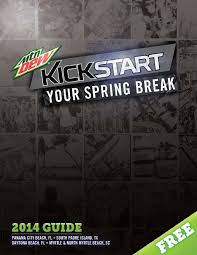
  • PepsiCo Kickstart’s Spring Break 2014

    At the start of every year, the Collegiate Marketing Group publishes a Spring Break Guide for college students across the nation. The guide was first published in 1992 providing travel tips, destination news and information on everything about Spring Break.

    kickstart

    The Collegiate Marketing Group specializes in the youth market and basically owns all territory related to Spring Break marketing. Their Spring Break Guide reaches an estimated one million students including the print and web publication as well as the students on social media.

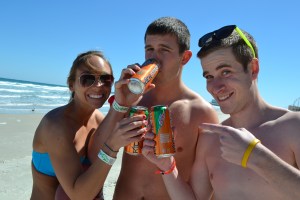
    This year, Pepsi’s new Mountain Dew energy drink, Kickstart, is the featured annual sponsor, replacing Coca-Cola. The shift in sponsor seems to be due to PepsiCo’s efforts in supporting the Mountain Dew brand.

    kickstart2

    Kickstart was introduced in February 2013, and sales surged to more than 100 million in the first 6 months. PepsiCo is planning on supporting Kickstart even more in year two. Kickstart was given a 35% media spending boost compared to its first year on the market.


    This 35% can already be seen through the increased spring break advertising PepsiCo has been sponsoring. There are a number of things that PepsiCo reveals about themselves by choosing to spend their marketing budget on college spring break guides.  The first is that it identifies PepsiCo’s target audience for this campaign. A second thing is they are trying to associate this drink and its brand with the spring break scene (party, lights, sun, fun, etc).

    kcikstart3

    While these 2 things stand out, there are many other things to examine in this campaign.  While you are on spring break, will you notice Kickstart and give it a try? We’ll see how PepsiCo and Kickstart do with their promotional campaign.

    – Rachel Gracy & Greg Rothman

  • “Together We Make Football” and Community

    When I think about the NFL, or football in general, my mind immediately goes to large men with helmets running into each other; granted, I am not a big sports fan.  Most people’s minds wouldn’t imagine a little girl as the face of a major NFL ad campaign.  However, tiny Samantha Gordon, a ten-year-old pee-wee football player from Utah, is featured on the first commercial of the NFL’s “Together We Make Football” campaign.

    0ap2000000247227

    “Together We Make Football” is a contest where football fans of all ages, shapes and sizes are encouraged to share their stories of how football impacts their lives and what it means to them.  The contest narrows down to ten finalists, with five invited to take part in Super Bowl XLVIII festivities.  These stories can be in video, picture or story form and are posted to the “Together We Make Football” website.  The winners are chosen by a panel of judges, and the site’s visitors are invited to “like” the different posts; although these likes don’t have any affect on the contest winners.

    So how can I, someone so inexperienced in all things NFL, take an interest in “Together We Make Football?”  By applying it to what I know.  This campaign is a perfect example of how subcultures form and become such tight-knit communities.  The Social Identity Theory of communication states that people have many different versions of themselves depending on the groups, or subcultures, they belong to.  Different social situations are what drive these separate “selves” to behave in certain ways.  The title alone explains why “Together We Make Football” exemplifies this theory.  Defining fans of football as a “we” takes thousands of people and brings them together into a single unit.

    nfl-rivals-has-arrived-bring-your-rivalries-into-the-game-now_niesg_0

    Social Identity Theory goes further, saying that people belonging to one group tend to favor others within the group at the expense of others on the outside.  This holds true in the NFL regarding team rivalries in which fans become passionately involved.  Rivalries are like a double-edged sword, bringing together fans of the same team while creating tension with the fans of the opposing team.

    “Together We Make Football” reminds us that all fans are the same.  Ultimately, the goal is for their favorite team to win.  The campaign reminds us that all fans have the same goal, though it might be for different teams.  It allows people to share why they love the game so much, which can bridge the gap between rivals.  The different fan groups can become a single football-loving “we” because of the “Together We Make Football” campaign.

    – Maggie Dowicyan

  • Training Fresh with Subway

    Athletes today are not only known for their moment of fame on the big screen during game day, but also, for their many appearances endorsing popular products, brands, and, restaurants. Subway is a restaurant chain not only known for their popular array of sandwiches, but, also for the many athletic spokespeople that work to promote their healthy food options. Surpassing McDonald’s in number of worldwide restaurants, Subway is most definitely a force to be reckoned with in the fast food industry.

    Being so high on the fast food chain, a restaurant of such magnitude wants only the best to represent their brand. This is why Subway has chosen to use well-known athletes as celebrity endorsements. They have been quick to snag star athletes from a plethora of sports and now appear to be greatly reaping the benefits of their decisions, but, why? How do these athletes help encourage everyday consumers to eat Subway? Easy!

    Subway prides themselves on being able to partner with big name athletes such as Nastia Liukin, Michael Phelps, Robert Griffin III and Apolo Ohno, but, they did not pick these celebrities at random. According to Tony Pace, SVP and global CMO of Subway “We choose fans of Subway who just happen to be famous.”

    One of Subway’s newest marketing campaigns utilizes their celebrity endorsements by asking them the simple question; what’s your favorite Subway sandwich? Each athletes answer can be found on the Subway website under the “Famous Fans” tab.

    sub

    The page includes a brief description of each of their fourteen supporters alongside the name of their favorite sandwich. Subway’s slogan is, “Subway, the official training restaurant of athletes everywhere.” This goes hand in hand with their promotion of healthy eating and low-calorie sandwich options. Yet still, many want to know why just the sight of their website or viewing of a thirty-second commercial clip makes us want to eat Subway.

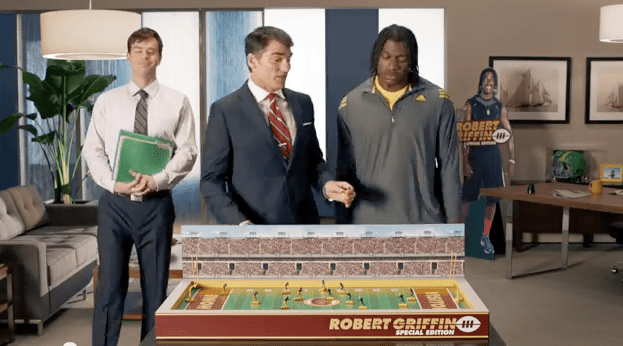
    It has to do with the attribution theory, studied in many communication and psychology classes. Viewers of Subway commercials see famous celebrity athletes supporting Subway and attribute their success to Subway and its healthy sandwich options. One of Subway’s newest commercials features the famous Washington Redskin’s quarterback, Robert Griffin III, better known as RG3. Throughout the commercial the narrator makes Comments such as, “RG3 trains hard and smart with low-fat protein-rich turkey breast” and “RG3 always scores with his fav, Subway turkey breast with spinach and tomatoes.” This creates an automatic correlation in the mind of consumers between the success of Robert Griffin III and his decision to eat at Subway.

    RG3

    As we continue to see RG3 and other athletes on Subway commercials, and hear about all of their many accomplishments, we will most likely continue to choose Subway as a top fast food restaurant. I mean, who else wants to eat at the same restaurant as Jarvis Jones, Mike Trout, and Carl Edwards? We do! This healthy promotion is one that has everyone giving Subway two thumbs up and a stamp of approval.

    -Caitlin Ford, Kaitlin Bateson, Parker Farfour, Alex Corrigan

  • Paula Deen Deep Fries Her Empire

    Upon hearing “Paula Deen” your first thought probably used to be of her traditional Southern food, restaurants, cookbooks, and television shows. However, within the past few months that initial thought has probably changed. Over the summer, accusations of Paula Deen making racist slurs flooded the news headlines. Within days of the incident’s reveal, corporations began to discuss dropping their sponsorship with Deen. With numerous household brands supporting her corporation, her empire was at a serious risk and her PR team was swamped.

    After Paula Deen’s racial slurs made national headlines, her initial contact with the media was questionable – she failed to show up for an interview with Matt Lauer and sent out two separate videos apologizing for ditching the interview, claiming she “would never intentionally hurt anyone.” Several days later, during her first interview about the accusations, she turned the events around, focusing on how hard these allegations have been on her and her family making close to no attempt to apologize for her actions. Her initial response was to apologize not only to Matt Lauer and the Today Show crew for ditching them, but to anyone who she may have hurt.  However, she used transcendence, an aspect of apologia that puts the issue at hand in a different context, in the interview when she said “I go into my kitchens and hear what these young people are calling each other. It’s very distressing for me. I think for this problem to be worked on these young people are gonna have to take control and start showing respect for each other.”  She had gone even further to use differentiation, another aspect of apologia, by stating that “The day I used that word was a world ago — I had a gun put to my head.” She is definitely trying to make herself sound like the victim of a much more serious act. What do you think of Paula Deen’s tactics on handling her latest scandal? She initially apologized to everyone for the accusations against her, but days later tried to turn it around to make viewers feel sorry for her.

    Sponsors dropped Deen’s brand and months passed with no word from the Emmy Award-winning T.V. chef – until this past weekend. This past Sunday, the “Queen of Southern Cooking” made her first public appearance in Texas since her controversy over the summer. Deen came back with a bang, receiving a ten-minute standing ovation from fans as she walks on stage, almost as if her fans have completely forgotten about the event over the summer. Some people felt that she did not spend enough time out of the limelight, but others say they’re ready for Deen to make her return. Despite her rocky and scattered PR strategy, an online survey conducted by LA. Times revealed that 92% of people are ready to see Paula Deen back on television. No one knows for sure what lies ahead for Paula Deen and her brand. Do you think it’s too early for Paula to make her return?

    – Tilson Hackley