Category: Media

  • You can’t have your Coke and drink it too

    It’s one of the pillars of successful marketing, target your audience. Individualizing ads to particulars groups or regions of consumers ensure that messages have the most impact. But what happens when a company features a controversial scene in a spot, then removes it for some audiences and not others? Good marketing move or failure to take a stance?

    In its newest global campaign, “Reasons to Believe” Coca-Cola set out to inspire consumers that no matter what happens in life, it’s those small happy moments that make life worth living.

    Check out the commercial below.

    In most European countries the ad contains a scene of two gay men holding hands in front of their wedding party. However, in the Irish version (the video below) the scene has been replaced to feature a bride and groom.

    The Irish LGBT publication, EILE Magazine, brought attention to the issue, calling the removal an “inexplicable move”. In response to the criticism, Coca-Cola said that the advertisement had been tailored to individual markets so that the ad resonates with the people in each country where it is shown. The company defends the decisions saying that grooms were excluded from the Irish version because gay marriage is not legal in the country. EILE Magazine claims the Coca-Cola reasoning moot. The footage of the two grooms is known to be a video clip from a same-sex union ceremony in Australia – equivalent to a civil partnership in Ireland. Yet gay marriage is also illegal in Australia, but shown there. EILE claims the spot should have been suitable for Ireland as well.

    Coca-Cola has unequivocally made public their supporting stance on same sex marriage. Since 2006, the Human Rights Campaign continues to award Coca-Cola with a 100 percent ranking of their company polices and practices regarding LGBT. The Coca-Cola Company notes on their website, “To achieve a perfect score, companies must have fully inclusive equal employment opportunity policies, provide equal employment benefits, demonstrate their commitment to equality publicly and exercise responsible citizenship”

    Many are saying that Coca-Cola’s recent actions were hypocritical. Coca-Cola claims to support gay marriage, but their choice to remove a gay marriage scene from a commercial in Ireland, in which law does not prohibit such imagery, is misleading of the company’s values. Similarly, another beverage icon, Starbucks, has also gained attention for their hypocritical actions.

    Bryant Simon discusses the company Starbucks in his book Everything But the Coffee. Through his research he comes to discover that Starbucks isn’t delivering what they are promising in their brand – good coffee with little environmental impact. Claiming to buy fair-trade coffee from Rwanda and Nicaragua farmers, Starbucks was actually buying from bigger farmers and only buying 5-6 percent of fair-trade out of all the total coffee purchases.

    Much like Starbucks claiming to be environmentally friendly yet not taking the necessary steps in order to be green, Coca-Cola’s actions were just as misleading; claiming to support gay marriage yet removing a scene from one version of a commercial for the sole purpose of trying to please everyone.

    As future and current brand ambassadors we have to remember that every decision we make, including company policy decisions, become an integral part of brand, and when decisions are made that contradicts that it hurts the brand.

    On the other side of things, as consumers (and as Simon states in his book) we have to remember pursuing “solutions to highly complex social problems through buying and buying alone” doesn’t fix the problem or change the ideology. We have to stop relying and believing that buying certain brands is going to change a social issue.

    So, does Coke’s decision to take out the gay marriage scene hurt its brand identity? Should companies take stances on social issues? What practices do you follow to make sure this brand conflict doesn’t occur in your company or with your clients?

    Savannah Valade, Caroline Robinson, Elizabeth Harrington

  • Dogfish Disaster Averted

    As we have gravitated towards becoming a society submerged in technology, in recent years, outlets of social media have become essential marketing tools for many companies and organizations.Facebook, Twitter, Instagram and Vine are few forms of social media utilized by most. While social media can strongly influence consumer behaviors and increase consumer awareness it can also be detrimental to a company’s image. In some cases social media can be the cause of a PR crisis. Crisis management is the process by which an organization deals with this major event that threatens to harm the organization.

    The American Red Cross is a prime example of an organization who exemplifies strong crisis management skills. This honorable humanitarian organization managed to dodge-a-bullet back in 2011 when an intern fired off a personal tweet on the company’s twitter account. The tweet read “Ryan found two more 4 bottle packs of Dogfish Head’s Midas Touch beer…when we drink we do it right #gettingslizzerd”.

    red cross

    This uniquely unorthodox and unprofessional tweet received a lot of negative attention from the general public. In this particular circumstance social media proved to be the cause of the crisis. When responding to the tweet the Red Cross avoided disaster by acknowledging that the tweet went out, deleting it, and explaining with humor that is was a mistake. This is an example of crisis management where the Red Cross turned a potentially harmful tweet in to an opportunity for engagement.

    Thankfully, the Red Cross realized the potential of social media and understood the power that it has to bring down a major organization. Now, other companies can look at this experience and utilize it to learn for themselves. After understanding the Red Cross’s response it is easy to break down their post-crisis steps and keep them in mind for other emergency situations. First, they were able to assess the situation. They realized the crisis was a major problem but they came to the conclusion that they could handle it which brought them to their second step, adapting their message. They considered their stakeholders and created a strong message to appeal to them. Lastly, they were able to analyze and learn from the situation post-crisis. Although this could have led to a horrific downfall for one of the greatest humanitarian organizations, everyone was able to benefit, understand, and learn from this experience.

    red cross 2

    -Parker Farfour, Caitlin Ford, Alex Corrigan, Kaitlin Batson

  • Paul McCartney’s NEW Publicity Stunt

    The digital world of iTunes and social media has given the music industry both high and low notes. While the Internet offers accessibility, it also caters to specificity. Most predominantly, the Internet offers an array of platforms for artists to upload, share, and send their music.  However, while music junkies may be constantly searching for new digs, most people eventually acquire a particular taste for what they choose to send through their ear buds.  Internet music services such as Pandora, Spotify, and iHeartRadio allow users to handpick and listen to an endless variety of artists and genres. This narrowcasting of music leaves artists waging campaigns to try to reach listeners. As a result, clutter prevails.

    Like in advertising, clutter has become a big problem in music promotion. As Douglas Rushkoff pointed out in The Persuaders, “The more messages they create, the more they have to create to reach us.”

    The more opportunity social media platforms – YouTube, MySpace Music, and most recently Vine – offer artist to share their music, the more competitive and important promotion of music and musician become.

    So how does a music artist break through all the online music clutter without breaking budget? The answer is: great music, a little luck, and a publicity stunt.

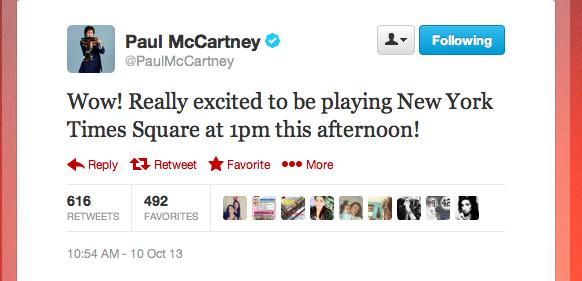
    Not new to the music arena are surprise gigs on rooftops or buses in the middle of big cities, events known in the public relations world as a publicity stunts. This past October, music legend Sir Paul McCartney promoted his recently released album, NEW, by doing just such a thing – performing a surprise concert in the middle of Times Square.

    Paul McCartney at performs at the Times SquareTelling fans only hours before – via Twitter – he played a 15-minute long show featuring the single “New”, as well as music from the (not at the time released) album. McCartney was not only able to give NYC fans a concert, but fans from around the world could tune in through Times Square live webcast and watch the performance.

    pm tweet nyThe surprise gig resulted in social media buzz and major news coverage, all promoting the NEW album for free. The stunt was so successful; exactly a week later he performed another surprise concert in London.

    pm tweet loSir Paul McCartney proved how to conquer the masses. Not only did he succeed in making his fans happy, but also he succeeded in executing a publicity stunt that generated both word of mouth and media coverage that ended up promoting his music at no cost to him.

    Caroline Robinson, Savannah Valade 

  • Ready or Not, Here We Come!

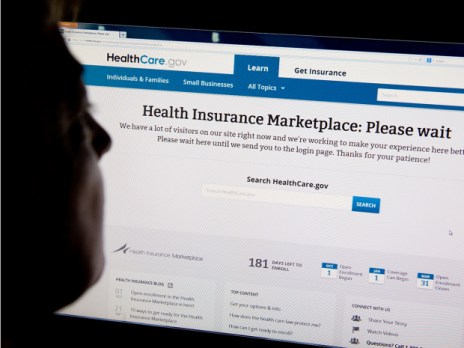
    Well, it wasn’t ready. The Affordable Care Act website, that is. Commonly known as Obamacare by critics, the program officially launched October 1, 2013 and attempts to allow each American the opportunity to have affordable health care. The program was signed into law in 2010, but only just now became part of daily American life. The website experienced technical errors last week, and again this past Tuesday. However, this was unrelated to the government shutdown. Instead, the system experienced a major overload due to mass traffic to the site, claimed those who run it. An estimated 8 million visitors forced the site to send a response of “Please Wait and Be Patient,” CNBC reports. Run by the Department of Health and Human Services, the process to acquire a health care quote is actually quite simple. I myself did it and, just shy of giving my contact information, I was inches from an affordable quote in less than two minutes.

    Page that loads with technical issues, courtesy of MSNBC
    Page that loads with technical issues, courtesy of MSNBC

    Fox News said that the 93 million dollar website was the victim of poor Java Script coding, to the point where, simply put, the site freezes up. It doesn’t know where to go or in which direction to proceed. Yet MSNBC follows the path of the HHS, saying it was simply a matter of visitor overload to the site. MSNBC did not report, as of posting, that there were Java Script coding issues.

    So. Which to believe? It is common knowledge that news stations lean differently towards their side, whether it be right or left. Even CNN, a major world news outlet, leans toward one side. This post is neither liberal nor conservative, and it neither promotes nor discourages the Affordable Care Act. However, it does encourage that American citizens not rely solely on one news outlet for information. Rather, gather your news from a multitude of sources. Otherwise a viewer faces the possibility of being a victim of “Spiral of Silence.” The Spiral of Silence is an instance where an individual, with one opinion differing from that of the majority, is unable to voice said opinion for fear of judgment. For instance, if I believe Theory X, but my neighborhood only watches one news channel that reports solely on Theory Y, the neighborhood will only be educated on Theory Y. If the entirety of the neighborhood, apart from myself, believes in Theory Y, I would be uncomfortable in expressing my opinions and differences. I am lost in the Spiral of Silence. If you support a cause that one news station does not, you are only educated on their belief. In the land of the free, is our free speech being suppressed by the media?

    -Hilary Hall