Category: Marketing

  • The Hunger Games are…Real?

    The Hunger Games: Catching Fire, opened on November 22, 2013 as a sequel to the Hunger Games. What started as a series of books by Suzanne Collins has been turned into a hit soon-to-be trilogy. Catching Fire made an estimated $158,074,286.00 on its opening night in the United States alone, according to IMDB. The blockbuster film partnered with many companies, including Subway and Feeding America. This trio has combined forces to also include Twitter in an effort to end hunger.

    As a result of Subway and Catching Fire being partners, Subway is currently using the tributes of the Games to encourage people to eat in the restaurant. This type of celebrity endorsement brings in people who might not normally eat there. “Oh, if Peeta eats Subway, I should too!” Granted, this behavior might come more from children but they, in turn, will ask their parents to take them to Subway. I’ve seen this time and time again with my younger siblings. This also works for the older crowd, however, because a partnership of this nature often includes promotional items or sales/deals that someone may anticipate being offered. Subway has transformed their marketing strategies and dining areas, with concepts like “Where Victors Eat” and “Win your own Victory Tour,” with the latter being a sweepstakes in conjunction with their collectible Catching Fire drink cups.r_kat1
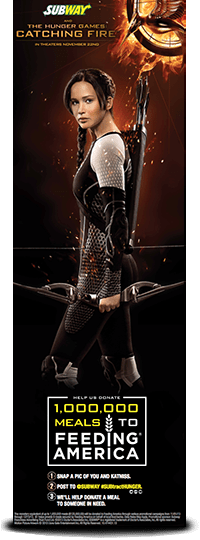
    In the third and final facet of this trio of partners, Feeding America has jumped in and put their cause directly in the middle. Subway has placed cardboard cutouts of tributes Katniss, Peeta, and Finnick in the dining areas of Subways. A patron, after eating “What Victors Eat,” can take a photo with the cutouts and post it to the Subway Twitter, with the hashtag of #SUBtractHunger. Each time a hashtag is used, it is counted towards the 1,000,000 meals that Subway will buy for Feeding America. In the fine print, it says that Subway will donate up to $125,000, as each dollar makes about nine meals. However, this linkage will only exist until 11:59pm on December 15, 2013. The meals will be provided from Feeding America through local food banks in areas in need.

    This celebrity endorsement effectively ties in cause marketing in order to create an environment in which Subway patrons are encouraged to aid Feeding America. Though there is no mention of patrons being able to donate money directly to Feeding America via Subway and Catching Fire, the Feeding America website has a donation area, as well as a hyperlink to a Hunger Games site, where a large “Ignite the Fight Against Hunger” plea is proudly displayed under a Mockingjay and above a photo of the tributes stoically ready to win the real-world Hunger Games. The number of families that go hungry over the holidays is continuously growing. With Feeding America, Subway, and the Hunger Games movie series teaming up to feed families, alongside many other organizations attempting to end hunger, do you think the odds are in are their favor?

    -Hilary Hall
  • Towels For Troops: Supporting Our Heroes

    I cannot speak for others, but one of the most quickly used products in my household is paper towels. Often times, it seems that they have to be bought on a weekly basis. Thankfully, Brawny, the paper towel company, recognized the necessity that paper towels have become and leveraged their product to help out a worthy cause.

    Last year, Brawny partnered with the Wounded Warriors Project to launch an “Inner Strength” campaign. For two years, Brawny has prided itself on standing strong alongside the Wounded Warrior Project (WWP) as a means of honoring injured service members. In 2012 alone, Brawny raised more than $500,000 for the WWP.

    hahahahaha

    For those of you who are unaware of the Wounded Warriors Project, it is a form of charitable support for members of the armed forces who were injured in the line of duty. Donations made to WWP help thousands of wounded warriors and their families as they return home from current conflicts.

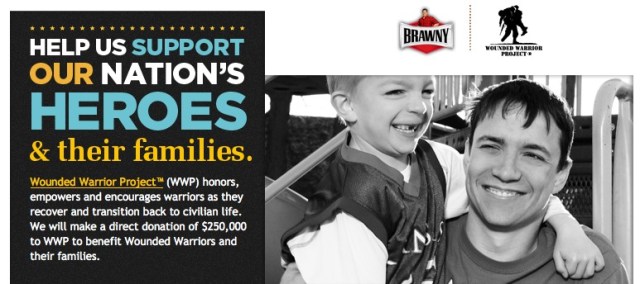
    With great success, Brawny decided to continue this cause marketing initiative committing to raise $600,000 this year. As a means of accomplishing this goal, Brawny has promised to make a direct donation of $250,000 to benefit the WWP. They have also announced their pledge to donate an additional $1, up to $350,000 for every individual who: shares a “Thank You” note on the Brawny Facebook page, “likes” Brawny paper towels on Facebook, or texts THANKS to 272969.

    Large goals like this are often hard to achieve, but worth it when it comes to a good cause. In the study of rhetorical theory, Greek philosopher, Aristotle teaches the three modes of persuasion: ethos, pathos, and logos. In this example, Brawny is able to use cause marketing to appeal to pathos or the emotion of the audience, but this tactic is commonly used in cause marketing. Pathos is the strongest mode of persuasion; making it a more frequently used appeal.

    Personally, when I hear the word “persuasion” I immediately make the connection to an interchangeable and more frequently used term…Influences. Persuasion is a process directed towards changing or influencing people’s beliefs, attitudes, and intentions. Individuals are persuaded each and every day. Persuasion is a critical and underlying goal of all marketing and advertising efforts.

    The “Inner Strength” campaign is an effective form of cause marketing conducted by Brawny and the WWP. This particular campaign does an efficient job of persuading customers purchasing decisions by appealing to the audiences’ emotions. Customers are much more inclined to buy a product if they know that it is for a good cause.  It is that simple.

    In this case, customers are buying Brawny products because it is to their understanding that a percentage of the proceeds go to the WWP. This is because these consumers feel a sense of sympathy for wounded soldiers. This is a form of persuasion at its finest. Ultimately, cause marketing has proven to pay off in this scenario seeing how Brawny sales are through the roof and donations made to the WWP are at an all-time high

    Happy Thanksgiving!

    -Caitlin Ford, Parker Farfour, Alex Corrigan, Kaitlyn Batson

  • Hyundai’s “Suicidal” Marketing Crisis

    In April of 2013, Hyundai released a commercial known as “Pipe Job” that left many people in the UK confused and shocked. The commercial’s primary goal was to illustrate the car’s new water engine emissions in a humorous way. However, due to this very commercial, Hyundai soon found itself in a potentially “suicidal” PR and marketing crisis.

    Image

    The ad was written about a topic that should clearly never be joked about and is very personal for many people across the world. The ad shows a man who is attempting suicide through inhaling harmful emissions, but fails due to the company’s new water engine emissions. Obviously, Hyundai released this ad in hopes that their audience would find humor in the failure of his attempt at suicide because of their water engine emissions. The company soon found that the ad produced the opposite effect. One of the main people who caused the uproar regarding this commercial was blogger Holly Brockwell. Holly wrote an emotional post regarding this poor taste in marketing.

    Image

    Unfortunately for Hyundai, this entire crisis could have been somewhat avoided. While of course it could have been completely avoided by simply never allowing the commercial to air, it could have also been avoided if the company had a crisis management plan implemented. Instead, Hyundai was slow in their apologies and even ignored reporters when they reached out for answers. This lack of communication for those with questions is what ultimately left Hyundai in a PR crisis that was nearly impossible to overcome. While Hyundai finally released apologies and statements, the damage that has been done is immeasurable. In the end, companies must be proactive when dealing with crises that involve their products to have a chance at managing them before they have a chance to become something larger.

    -Ryan Nagy

  • #YTMA… What’s that?

    This past Sunday, November 3rd, YouTube decided to take a leap and reinvent the fundamentals of music video awards as we know them; YouTube held their inaugural YouTube Music Awards (YTMA). The live-streamed event, sponsored by Kia, took place in New York City. Directed by Spike Jonze, YTMA was an interesting and unconventional mix of miscellaneous acts, unscripted hosts (Jason Schwartzman and Reggie Watts), and awkward moments. Although they received criticism of their “home made” feel they did one-up their MTV awards competitors in one aspect, along with live performances by popular artist such as Eminem, Lady Gaga, and Arcade Brothers they also incorporated “live music videos”.

    According to Ad Age, YouTube averages more than 1 billion viewers each month and is owned by Google, the most powerful of all internet companies. With this is mind we can only assume that the YTMA was a huge success. Wrong! The viewership was astonishing low, it was only viewed by 220,000 people at its peak; to put this into perspective the MTV VMA’s viewership was at 10.1 million this year.

    So where did they go wrong? Although both Kia and Youtube advertised on their websites’ homepages for some time prior to the event. YouTube neglected to realize the importance of advertising on their mobile app.  This was a huge miss to their prime public because mobile apps are 40% of where their user base are present.

    Also, unlike watching music video awards on TV, YouTube had a social media disadvantage.  Like many live TV events YMTA did have a hashtag, #YTMA, for viewers to tweet while watching the event. The hashtag reached a decent number of about 30,000 tweets, but there was potential to have had much more. Once again they forgot to keep in mind that many of their viewers watch from mobile devices, making it difficult to watch and tweet at the same time. This resulted with a large decrease of tweets about YTMA when the event went live, which possibly hindered other tweeters to start viewing.

    These two factors alone go against the Audience Theory by Chaïm Perelman and Lucie Olbrechts-Tyteca which states “approaches will achieve the greatest adherence according to an ideal audience.”  YouTube’s target audience is the social media and mobile users, and because YouTube did not take into account these minor but impacting factors, it may have cost them viewers.  Nicholas Carr the author of The Shallows says, “most TV shows and movies are also trying to become more Web-like”. I think YouTube may be going in the wrong direction. They have excelled as an online video website, for their sake they should keep it that way and stop trying to be more TV-like.

    -Kelsey Raskob

  • “Together We Make Football” and Community

    When I think about the NFL, or football in general, my mind immediately goes to large men with helmets running into each other; granted, I am not a big sports fan.  Most people’s minds wouldn’t imagine a little girl as the face of a major NFL ad campaign.  However, tiny Samantha Gordon, a ten-year-old pee-wee football player from Utah, is featured on the first commercial of the NFL’s “Together We Make Football” campaign.

    0ap2000000247227

    “Together We Make Football” is a contest where football fans of all ages, shapes and sizes are encouraged to share their stories of how football impacts their lives and what it means to them.  The contest narrows down to ten finalists, with five invited to take part in Super Bowl XLVIII festivities.  These stories can be in video, picture or story form and are posted to the “Together We Make Football” website.  The winners are chosen by a panel of judges, and the site’s visitors are invited to “like” the different posts; although these likes don’t have any affect on the contest winners.

    So how can I, someone so inexperienced in all things NFL, take an interest in “Together We Make Football?”  By applying it to what I know.  This campaign is a perfect example of how subcultures form and become such tight-knit communities.  The Social Identity Theory of communication states that people have many different versions of themselves depending on the groups, or subcultures, they belong to.  Different social situations are what drive these separate “selves” to behave in certain ways.  The title alone explains why “Together We Make Football” exemplifies this theory.  Defining fans of football as a “we” takes thousands of people and brings them together into a single unit.

    nfl-rivals-has-arrived-bring-your-rivalries-into-the-game-now_niesg_0

    Social Identity Theory goes further, saying that people belonging to one group tend to favor others within the group at the expense of others on the outside.  This holds true in the NFL regarding team rivalries in which fans become passionately involved.  Rivalries are like a double-edged sword, bringing together fans of the same team while creating tension with the fans of the opposing team.

    “Together We Make Football” reminds us that all fans are the same.  Ultimately, the goal is for their favorite team to win.  The campaign reminds us that all fans have the same goal, though it might be for different teams.  It allows people to share why they love the game so much, which can bridge the gap between rivals.  The different fan groups can become a single football-loving “we” because of the “Together We Make Football” campaign.

    – Maggie Dowicyan

  • Name Changer

    Tailgating, body paint, jerseys, good luck rituals, and an unparalleled fraternity all exist as part of sports fandom. People love their teams – and love anyone else who also loves their team. Such loyalty has become an integrated part of sports culture sociology.

    Social Identity Theory states that by wearing team colors, attending games, knowing the players’ names, positions and stats, a fan begins to feel as if they are an integral part of the team – they connect with the team as if they were playing the game themselves. This connection explains why even poor performing teams have avid supporters. However, it is ultimately marketing that fosters fan identity. After all teams are brands; encompassing colors, logos, and mascots.

    fans, blog 3

    Fan loyalty has elevated sports to become part of our commodity culture; a product to be bought and sold, meaning big bucks for team owners. High-level sport has been transformed into a commercialized, commodified, and massified phenomenon. Therefore, fan identification and brand commitment become two key factors in managing and marketing a team. Building a brand is hard, but building and maintaining a culture of fans is much harder.

    As we transition into fall, we know that means one thing in sports,  football is king. With the NFL season in bloom, one team in particular, the Washington Redskins, are off to a rough start. The return of RG III has been very anti-climactic and on top of the team’s poor performance, a greater worry looms in the background: the franchise is under pressure to change the team name.

    Many believe the team’s name, “redskins”, is derogatory and racist due to its historical connotation and use to alienate and belittle Native Americans. The acclaimed Peter King from sports illustrated has even decided to stop using the name, saying, “I don’t want to add to the offensiveness.” Pressure to change the team’s name has been mounting for years and this past spring 10 congress members sent letters to the team owner and NFL requesting them to change the name. One Native American group, the Oneida Indian Nation, has started to take action and run ads in D.C. about the offensive name in hopes of rallying up support.

    rs logo, blog 3

    Whether you are an avid supporter for the name change, an avid supporter of the Redskins, or just don’t care, you can’t deny that team names mean a lot in the sports industry. Which leads us to the question: does a new name mean a new team? Does the team culture change when a team redesigns?

    These are exactly the questions the NBA juggled this past summer when they chose to revert the Charlotte Bobcats back to their former team name, the Charlotte Hornets. Coming onto the basketball scene in the ’90s, the Charlotte Hornets created a unique culture. With Hugo the Hornet as the mascot and teal uniforms, the Charlotte Hornets were a recognizable brand. So when the NBA decided to change the team name it was a hard transition for many loyal and devoted fans. Unable to identify with the new team and culture the fans gave up support and the fall of the Bobcat brand ensued.

    Reverting back to the original team name rejuvenated Charlotte fans. There was an immediate increase in the amount of ticket sales; quantitative proof that the Hornet name had been sorely missed. By keeping the team name consistent with what the fans wanted, the Charlotte basketball team re-strengthened their brand significantly.

    However, Washington, unlike the Bobcats, doesn’t have a sorely missed brand. In fact, the Redskins name is so beloved the proposition of changing the team’s name is being met with great opposition. Owner Daniel Snyder commented he would never change the name saying, “the Redskins’ fans understand the great tradition and what it’s all about and what it means.” Even NFL Commissioner, Roger Goodell, described the team name as a “unifying force that stands for strength, courage, pride, and respect.”

    Even if Snyder wanted to change the name it would be hard to change the minds of brand followers who have spent years identifying with the team, purchasing the merchandise, rooting for the players, and most importantly making memories. Ditching the derogatory name may ultimately come to a forced decision but the implications involved are massive. It boils down to a relatively simple equation: fan identification and brand commitment work together to produce the main goal in sport commodity, revenue. So the most important factor to ponder: the fans. How is the team going to remarket and rebrand to get fans to commit to a team they may no longer identify with?

    Savannah Valade, Caroline Robinson, Meghan Carey, Morgan Jones

  • “Everything for U”: Target’s Brilliance…Part Two

    Since Target has proved their brilliance once again with their back-to-school marketing and advertising campaigns, we just had to talk about it again! For years, companies have struggled to invent new and innovative ways to advertise this exciting time of the year.  However, Target has perfected profitable, long-term campaigns and has successfully created fresh, new advertising strategies.

    img-thing

    As Thursday’s post mentioned, Target has been successfully hosting Target After-Hours Busing Events for twelve years.  Adding UNCW to its list of schools this year was very popular amongst students in Wilmington. The idea of getting to shop for trendy dorm and apartment materials after hours gives students the feeling that Target is catering to their needs personally. This year, Target took that personal touch one step further.

    With all the hype surrounding live events and social media, Target decided to try their hand at it as well.  Bullseye University, Target’s back-to-school campaign, created five dorm rooms decorated with Target products that real, soon-to-be college students lived in from July 15th to July 18th.  Viewers could interact with the participants by asking questions through social media, entering drawings, and purchasing products without interrupting the streaming video.  This campaign is the perfect way to reach their target audience, college student. Target has not just promoted their brand, but has given their audience an opportunity to interact with their brand.

    Advertising enforces the idea of a Commodity Culture.  Commodities are marketable items that satisfy the wants and needs of consumers.  In many ways commodities are a central aspect to a culture’s values, traditions, and meanings.  Target has mastered the idea of appealing to the Commodity Culture, especially in its Back-To-College marketing strategies.  On their Back-To-College webpage, the “…for U” theme is prevalent for every category of dorm essentials.  The home page advertises an end of back-to-school-season sale, with “Deals for U” stamped in the corner. When you click on “college bedding,” a picture of the many colorful Twin XL beds that college freshmen are so familiar with, with the phrase “Zzz’s for U” in the same position.  Target’s website is advertising the personalization aspect of their products to college students.  Making sure their dorm room, or apartment, and school supplies are able to tell the story of who they are to their classmates.  Commodity Culture states that people define themselves by what they purchase.  Target understands that young adults are finding themselves in college and want to stand out, which they encourage by allowing this personalization.

    everything-for-you-footer

    -Maggie Dowicyan, Tilson Hackley, Hilary Hall, Kelsey Raskob, Christine Schulze