Category: Government

  • THIS IS FAKE NEWS! NOPE… IT’S REAL

    Would you know fake news if you saw it? How often have you come across fake news during your time on social media? I’m betting more than once. Believe it or not, in the past few years, platforms created algorithms to reduce the amount of fake news flooding your stream. But how well has that worked?

    Hunt Allcott and others found specific trends in the diffusion of misinformation in social media. They gathered thousands of pieces of content and stories from over 100 fake news websites and their level of engagement with Facebook and Twitter and reviewed the trends of their diffusion from 2015 to 2018. Using various web trafficking methods such as BuzzSumo and Alexa, they reviewed the volume of user interactions and recorded browsing data. Yeah, they can do that.

    Allcott’s research also measured the outcomes for not only major sites, but small business and culture sites, and small news sites not identified as producing misinformation (Allcott, 2019). But those sites followed a stable trend in comparison to Facebook. Even so, some of the fake news sites also contain true news and clickbait to misleading content. Because of that reason, the researchers also compiled a list from Snopes.com that fact checked the content they deemed false. That gave them still a whopping 9,540 false stories! Later described in the article, the data could be misconstrued because of the sites these programs don’t account for.

    The amount of misinformation leading up to the 2016 election is alarming and fake news on social media is argued to play a major role in the results. Because of the increased volume of fake news, Facebook and other platforms created an algorithm to flag false content in order to prevent the spread of misinformation and improve its quality. The amount of decline within the past 2 years has suggested that Facebook’s algorithm may have something to do with it (Allcott, 2019). But, it’s nearly impossible to control the amount of misinformation people put out into the world.

    The results suggest that since the end of 2016, Facebook has had a decline in fake news since its peak while Twitter is still rising (Allcott, 2019). This change in the continuous rise after the election could have something to do with the President’s recent engagements on Twitter. The results from Facebook show relationship to major news and fake news sites engagement through the same periods of time. While Twitter engagements are on a continuous rise through the entire study due to the president’s active account and rising millenial use.

    This study seeks out to share the importance of knowing the decline is visible but the amount of misinformation still being consumed by viewers is large and alarming (Allcott, 2019). That’s mainly referring to Twitter and Facebook. Though Facebook’s fake news has declined from 160 million to 60 million engagements per month, the number is still high. And that’s just from one social media platform! Imagine the generations who get their news from major news sites that also carry false content not in this study. That just adds to the number of people exposed to things that can persuade one’s decisions.

    As communicators in the IMC world, it is our job to persuade and influence, however, in an ethical and approachable manner. Seeing this research has only solidified the fact that people are aware of the content put on social media. What is said online is shared and impacts society more than it seems. Allcott (2019) concludes that the diffusion of misinformation through social media is a potential threat to democracy and broader society. As a young generation of communication students, it is our responsibility to create content that is honest and thought-provoking in an ethical way.

    We remember the social media chaos that surrounded the 2016 Trump election but it makes you wonder about the effect a continuous amount of misinformation would have on a society and future elections. The research suggests there was a decline, however, there is still a problem. We, as marketers, need to keep in mind ethical values and the content we create and post- whether it be personal or business related. The fact is, on the internet, the information you share will be seen by someone out there, so don’t be fake, be real.

    Allcott, H., Gentzkow, M., & Yu, C. (2019). Trends in the diffusion of misinformation on

    social media. Research & Politics, 6(2), 205316801984855. doi: 10.1177/2053168019848554

    -Annie Cline

    Annie is happy to bring her creative writing skills into her studies with IMC. She has a passion for communication and cannot wait for graduation to put her skills into action in the real world.
     

  • @POTUS

    rt-rump-plane-mem-161206_12x5_1600

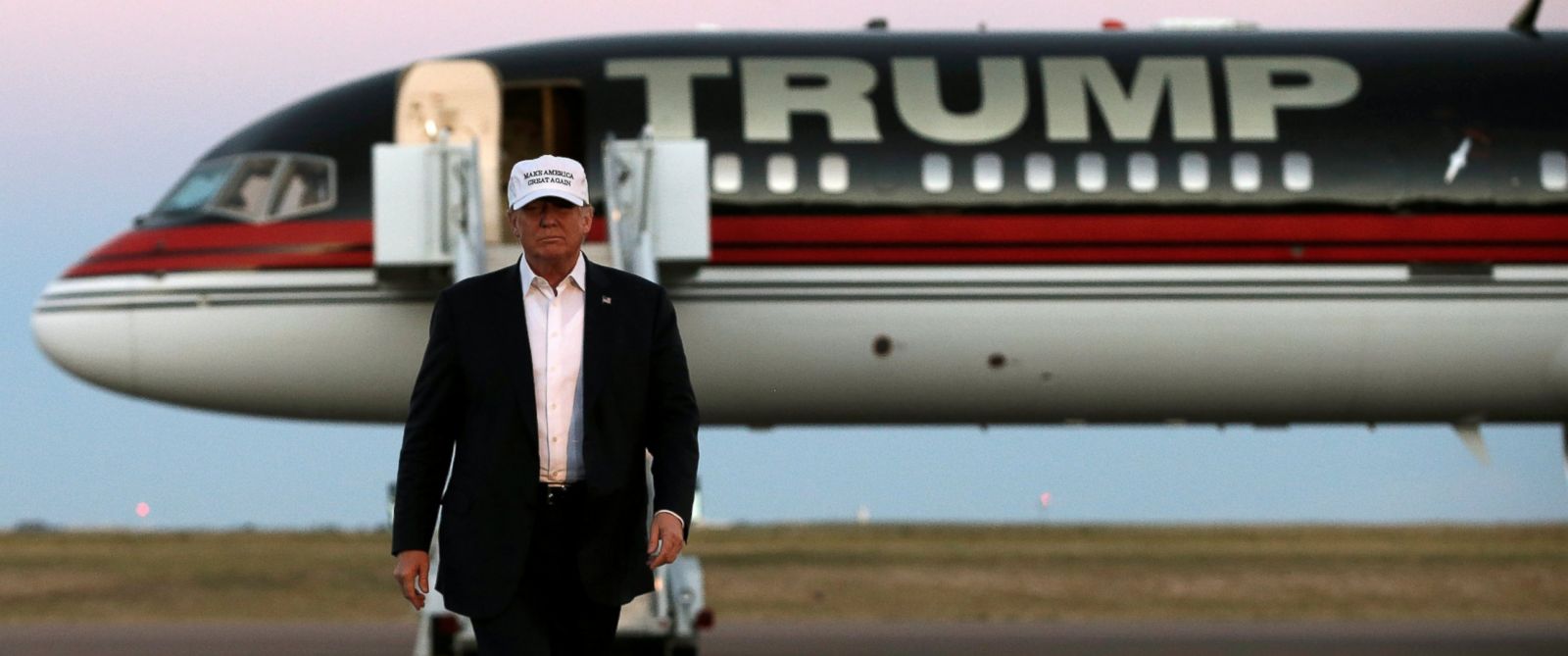
    Donald Trump as a citizen and as a presidential candidate was known to get himself into sticky situations on social media, more specifically Twitter.

    @realDonaldTrump engaged heavily in Twitter communication during the course of the election cycle. His ‘twitter-happy’ personality often came across aggressive and disrespectful. However, this was the brand that Donald Trump created for himself, as he knew what I was getting himself into.

    screen-shot-2017-02-03-at-10-14-41-am
    Donald Trump, just minutes before the inaugural ceremony, took the time to tweet for the first time with his newly adopted Twitter handle @POTUS.

    A little less than a month ago, on January 20th, Donald J. Trump was sworn into the Office. Also on that day, the now 45th President adopted the Twitter handle @POTUS. With this transition comes a bigger responsibility of how the President chooses to communicate using social media. President Trump must now reinvent his social media communication strategy, and re-brand himself as the President of the United States.

    Former President Barack Obama was the first president to utilize Twitter to communicate with the nation; However, the 44th President was not nearly as dependent on this form of communication as is President Trump.

    screen-shot-2017-02-03-at-10-21-03-am

    Ever since President Trump entered office, he has been utilizing Twitter and Facebook heavily. I have personally seen several events streaming live via Facebook. As many of us know, it can take up valuable time to generate a powerful message with only 140 characters. As students who are studying communication, we understand that a key skill to have in the process of “managing mutual responding” is to be able to generate effective and efficient messages to convey understanding to listening parties. It is not easy, especially with a limit of 140 characters. President Trump, however, seems to have no problems generating messages throughout the day among his Presidential duties. I can almost see the book on the shelf now…The Art of the Tweet by Donald Trump.

    Regardless of anyone’s opinions of President Trump’s policies, decisions, and beliefs, he is still breaking through barriers by trying to cut out the middleman in bringing you important information. If he is able to maintain ‘presidential etiquette’, do you think it is appropriate for President Trump to continue his frequent tweeting? Can this help prevent news sources from misinterpreting his attitude towards something, or an event that occurred? Just a couple points to think about.


    ~ Ben Yerby


  • FCC Reviews Rules and Regulations

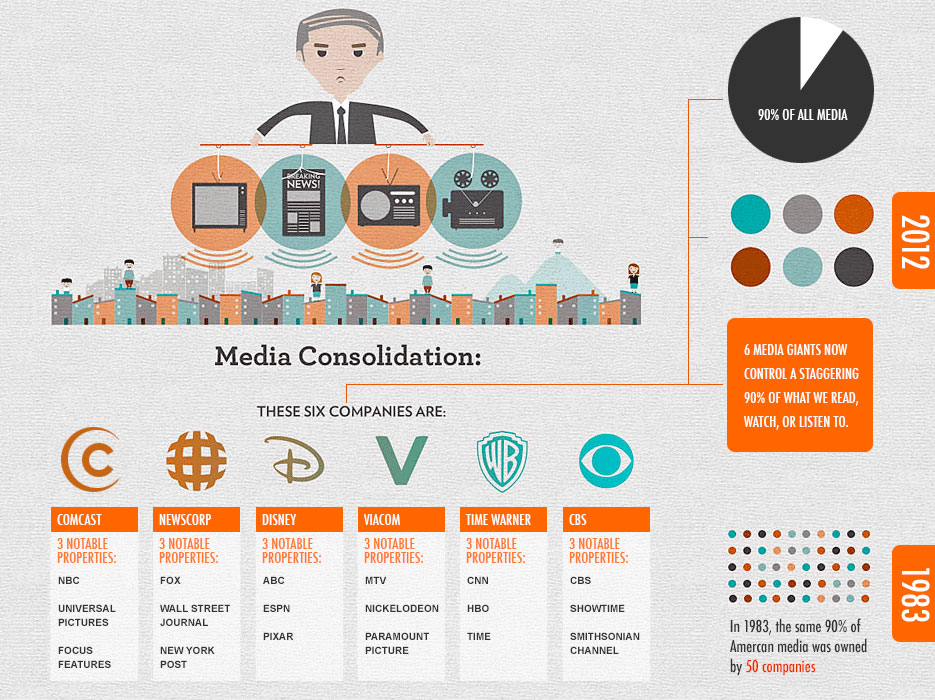
    As the final four teams prepare to battle it out in March Madness, it’s a sure bet that sports fan are waiting to see what else the tournament has in store this season. With coverage, updates, and analysis, it’s also a pretty sure bet that these fans are tuning into ESPN – the station that has become the sports authority. But did you know that the testosterone filled station is owned by a company that producers princesses fairytales – Disney? Did you know Disney also owns ABC, Marvel, Pixar, and Touchstone. Part of what’s known as the “Big Six” – Comcast, News-Corp, Disney, Viacom, Time Warner, and CBS – account for 90% of media ownership across the ­states.

    media_consolidation

    The process of consolidation through mergers and acquisitions, has led to media conglomerates – few companies owning all of the media outlets.

    Many argue that media consolidation hurts competition by blocking out new media companies. According to Senator Wellstone, media give people access to a wide variety of opinions, analyses, and perspectives and it holds concentrated power accountable to people. With only a few companies controlling all the media the two functions of media (listed above) are compromised. Specifically related to advertising, a combination of media also leads to monopoly over audience and advertisers.

    Today, the Federal Communication Commission (FCC), an independent US government agency responsible for controlling media regulation, will vote to make TV station’s joint sales agreements (JSAs) subject to current ownership rules. The commission will also vote on a rule that prohibits two or more of the top four TV stations in a market from jointly negotiating agreements with pay TV providers.

    Tom Wheeler, FCC Chairman, cited that the considered changes were motivated by evidence that suggested the rules that protect competition diversity and localism have been circumvented.

    JSAs are an arrangement many see as a loop hole around the limits on owning no more than two TV stations in a market. With endorsement from the Department of Justice, the FCC is now moving ahead with the rule “that if the owner of one station in a marketing sells 15 percent or more of the advertising time for another, then it will be deemed to have ownership interest in the station.”

    Broadcasters are fighting back. Gordon Smith, president and CEO of the National Association of Broadcasters, says, “The real loser will be local TV viewers. This proposal will kill jobs, chill investment in broadcasting, and reduce meaningful minority programming and ownership opportunities.”

    Stations that do have JSAs will have two years to dismember deals. However, stations can apply for a waiver in which JSAs will be examined on a case by case basis to determine if public interest is served by keeping the agreement.

    Additionally, as part of the 2014 review, the FCC will propose to keep the ban on owning more than two TV stations, but question whether the cross-ownership ban between TV, radio, broadcast, and newspapers should be lifted.

    However, while the five commissioners of the FCC will all vote on the issue, the ultimate decision may be left in the hands of just one, Democratic commissioner Mignon Clyburn. The issue has split the five down party lines with the GOP commissioners, Ajit Pai and Mike O’Rielly speaking out against the proposal. In order to advance the ruling, Wheeler will need the favor of both democratic commissioners.

    While the commissioners are deciding, we are left wondering to what degree will these rules affect our media markets? Will Clyburn’s decision trend toward more or less regulation?

    Tell us what you think. Should the FCC approve the JSA rule? Are media conglomerates affecting the free flow of information to society? Or has the Internet made possible enough independent outlets?

    Savannah Valade, Caroline Robinson

  • Ready or Not, Here We Come!

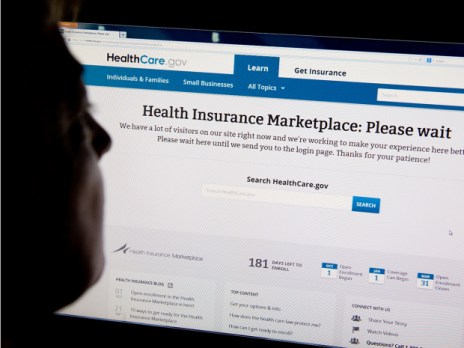
    Well, it wasn’t ready. The Affordable Care Act website, that is. Commonly known as Obamacare by critics, the program officially launched October 1, 2013 and attempts to allow each American the opportunity to have affordable health care. The program was signed into law in 2010, but only just now became part of daily American life. The website experienced technical errors last week, and again this past Tuesday. However, this was unrelated to the government shutdown. Instead, the system experienced a major overload due to mass traffic to the site, claimed those who run it. An estimated 8 million visitors forced the site to send a response of “Please Wait and Be Patient,” CNBC reports. Run by the Department of Health and Human Services, the process to acquire a health care quote is actually quite simple. I myself did it and, just shy of giving my contact information, I was inches from an affordable quote in less than two minutes.

    Page that loads with technical issues, courtesy of MSNBC
    Page that loads with technical issues, courtesy of MSNBC

    Fox News said that the 93 million dollar website was the victim of poor Java Script coding, to the point where, simply put, the site freezes up. It doesn’t know where to go or in which direction to proceed. Yet MSNBC follows the path of the HHS, saying it was simply a matter of visitor overload to the site. MSNBC did not report, as of posting, that there were Java Script coding issues.

    So. Which to believe? It is common knowledge that news stations lean differently towards their side, whether it be right or left. Even CNN, a major world news outlet, leans toward one side. This post is neither liberal nor conservative, and it neither promotes nor discourages the Affordable Care Act. However, it does encourage that American citizens not rely solely on one news outlet for information. Rather, gather your news from a multitude of sources. Otherwise a viewer faces the possibility of being a victim of “Spiral of Silence.” The Spiral of Silence is an instance where an individual, with one opinion differing from that of the majority, is unable to voice said opinion for fear of judgment. For instance, if I believe Theory X, but my neighborhood only watches one news channel that reports solely on Theory Y, the neighborhood will only be educated on Theory Y. If the entirety of the neighborhood, apart from myself, believes in Theory Y, I would be uncomfortable in expressing my opinions and differences. I am lost in the Spiral of Silence. If you support a cause that one news station does not, you are only educated on their belief. In the land of the free, is our free speech being suppressed by the media?

    -Hilary Hall