Category: Football

  • After 10 years of “Crashing the Super Bowl,” Doritos is Trying Something New.

    In 2006, Doritos broke the mold of Super Bowl Advertising by putting consumers in control.

    Frito-Lay’s “Crash the Super Bowl” ad campaign is probably one of the famous ad campaigns in Super Bowl history. Between 2006-2016, Frito-Lay ran an annual commercial contest, which encouraged fans to create commercials to be aired during the game. Finalists had the chance to have their content aired during the Super Bowl and winners received bonuses between $400,000 to $1,000,000.

    Beginning before the Golden Age of consumer-generated content on platforms like YouTube, Facebook and Twitter, Doritos’ approach was truly revolutionary. The “Crash the Super Bowl” campaign aired the first consumer-generated commercial on television called “Live the Flavor.”

    Many credit the “Crash the Super Bowl” campaign for granting legitimacy to the amateur consumer-generated content that would come to drive marketing on social media platforms. During the time Doritos started their campaign, consumer-generated content was just starting to take root. As technology on the internet improved, it provided consumers with a platform on which to share their voice. Over the course of ten years, fans submitted roughly 36,000 submissions for the chance to be featured during the game. Dorito’s typically chose winners they believed would score high on the USA Today’s Ad Meter. Doritos ads frequently scored high in the Ad Meter’s rankings and consistently made the Top 10 in ACE Metrix’s rankings from 2010-2016.

    Top 3 Rated ACE Metrix Doritos Ads

    Sling Baby

    Pug Attack

    Man’s Best Friend

    The rise of amateur digital content online ultimately contributed to Doritos decision to retire the campaign. In 2016, Doritos announced that it would end its annual “Crash the Super Bowl” contest. North American Frito-Lay Chief Marketing Officer Ram Krishnan explained in an interview with Ad Age that the campaign when the contest originally started it offered a stage for amateurs to be discovered for their work. Now, Gen Z is “not waiting to be discovered. They themselves are earning success by putting out their own YouTube channel and creating content for that. The role of the brand and the value that we add with this consumer has changed.”

    After 10 years of running the “Crash the Super Bowl” campaign, Doritos took a hiatus for the 2017 Super Bowl game. Fans need not worry that the brand is gone for good from the game, though. Frito-Lay announced this year that Doritos would return to the Super Bowl in a combined ad with Mountain Dew in an effort to court Millenials and Gen Z. Although advertising two products in the same ad can be risky, Jennifer Saenz, chief marketing officer for Frito-Lay America, believes that it will work. “If you look at the purchase habits of consumers,” she said, referring to company research, “Doritos and Dew are purchased together in more of the same baskets than peanut butter and jelly.” The ad campaign features Morgan Freeman and Peter Dinklage in a face-off between Doritos Blaze and Mountain Dew Ice. See a sneak peek of the campaign:

    What do you think about this new approach? Do you think it will be more effective than the consumer-generated “Crash the Super Bowl” campaign? What is your favorite Doritos commercial? Comment your answer below.

    – K. Layne Smith

  • When the Bandwagon Fans Fall Off

    Living in the US, the NFL is easily one of the most recognizable brands we come into contact with on a daily basis. More specifically, living in North Carolina, we are fully immersed in the mania and hype of “Panther Nation.”

    blog-1
    (Courtesy of @IGpanthernation via Twitter)

    The Carolina Panthers, like other franchises, maintain a prominent and consistent brand image among their target demographics. There are numerous ways that an organization of this magnitude must communicate with its audience in order to stand out among the many notable NFL “power franchises.” The typology, or types of messages that an organization delivers, must be tailored to the situation, the environment, and the audience that they are trying to reach.

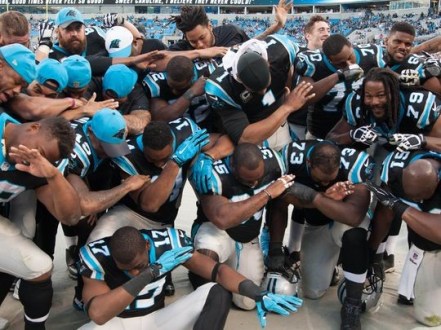
    The 2015 NFL season is one that Panthers fans will not soon forget. The team’s star quarterback, Cam Newton, and his fellow teammates rose in popularity as they went on a 15 game winning streak. The team was frequently seen unapologetically posing for mid-game photo-ops, while “dabbing” on their competition.

    blog-2
    (Photo: Jeremy Brevard, USA TODAY Sports)

    Cam Newton was awarded the coveted title of league MVP and the team even made an appearance in the Super Bowl. I think it’s safe to say that a season like that makes the marketing team’s job quite easy. First of all, the media delivers a great deal of positive, unplanned press for a consistently victorious team. There was even hype created about “the perfect season” before it even happened!

    (Joseph Person, The Charlotte Observer)

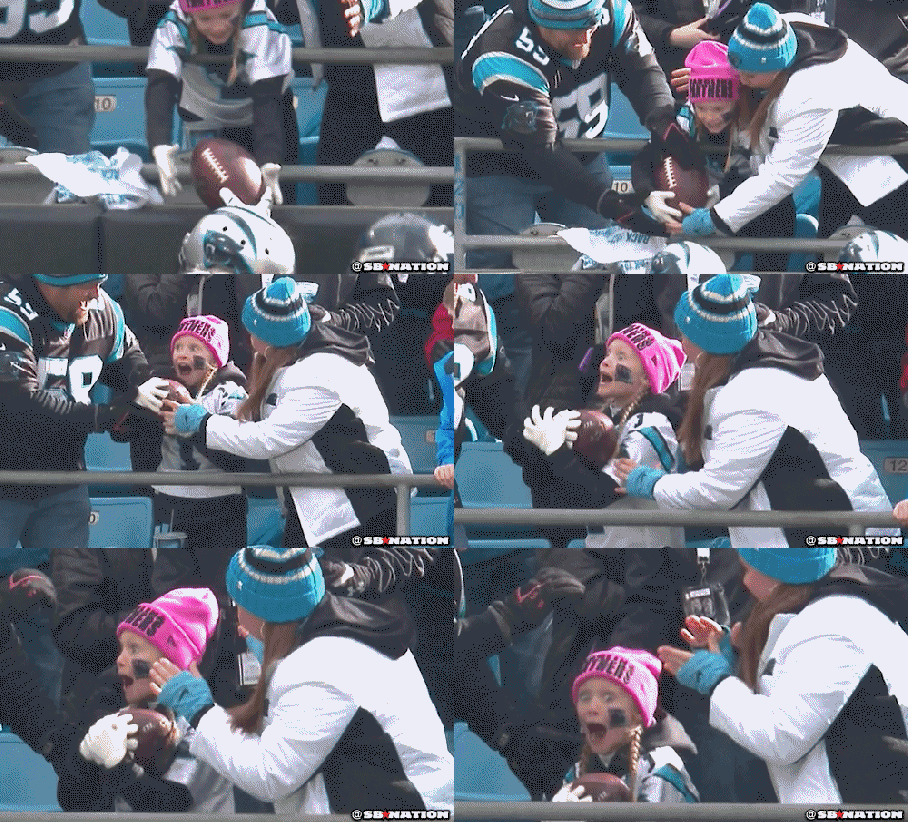
    They were heavily represented by the media in a positive manner. The message was either about another Panthers victory, or something equally as amazing like Cam throwing his insane number of touchdown balls to kids in the stands.

    panthergif

    Secondly, football fans are obviously more likely to root for a team that delivers wins. Panthers fans began to come out of the woodwork to see what “Super Cam” or “Luuuuuke” would do at each game. Advertising and social media material was at no shortage due to their strongly positive image in the media, as well as their ever growing, ever enthusiastic fan base.

    The marketing and branding techniques of the organization seemed to shift in a new direction after the crushing Super Bowl loss to the Denver Broncos. The social media updates, advertising, and media coverage transitioned to a much more humble, appreciative tone. The constant stream of “Keep Pounding” updates quickly transformed into a message of “We will work harder” and “next year is our year.”

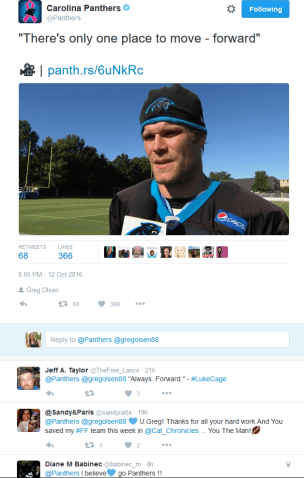
    Unfortunately for the Panthers, the 2016 season has certainly not been their year. So far the team’s record is 1 win and 5 losses. Even worse, their MVP sustained a concussion along with several other key players being placed on injured reserve. This has placed the organization at the bottom of the NFC South Conference. Their current struggle has caused a shift in the typology of the organization’s communication methods. Instead of relying on positive media attention and bandwagon fans, the focus has been more on philanthropy, hard work, and the “ride or die” fan base. Without the epic victories and record breaking plays to broadcast, the Panthers are forced to look for content that comes from within its organizational culture and soul. Recent communication from the Panthers places a larger impact on team motivation and hope for the future:

    blog-5

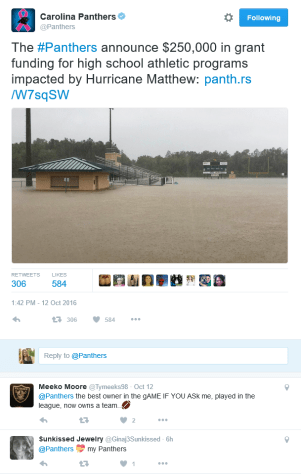
    While other messages highlight the organization’s charitable efforts and donations.

    blog-6

    A small sigh of temporary relief likely comes from the generally supportive response the Panthers have received from their true fans:

    blog-7

    Although the NFL audience may be harsh and unforgiving at times most fans stay loyal to their favorite team, no matter how stormy the weather. The determination and optimism found within the typology of the Panther’s messages will likely resonate with true fans and keep them coming back for more!

    blog-7-new
    (Jeff Siner, The Charlotte Observer)


    Are you a Panthers fan? If so, are these communication strategies keeping you hopeful for your team, or are you fed up and just ready to see some wins? Let us know what you think!


    -“PR and IMC: The Benefits of Integration” Public Relations Quarterly, Fall, 1994, 38-44

  • Brands – The Biggest Fans in the Game.

    According to ESPN.com, 49 percent of Americans are football fans…but just in case you’re not among them, football season can also mean a whole new ball game in the world of advertising.

    Companies will capitalize on anything they can and football season is no exception. Brands launch new campaigns both in preparation for, and during the season, in order to take advantage of the huge draw from football audiences. By gearing their products and services towards this huge target market, companies can add a new segment to their customer base regardless of whether they are directly related to football or not.  Advertisement strategies will range from direct involvement through sponsoring the NFL to simply trying to profit off the hype.  Football fans who are considering the Bojangles 20 piece jumbo tailgate special now have extra incentive to make Bojangles their game day choice. Bojangles is embracing football season with their second year of offering up football shaped Bojangles biscuits. These tasty bites are available for a limited time until September 26th.

    Boberry

    While food and football go hand in hand, make-up is a less traditional, yet still relevant way to show your team spirit.

    CoverGirl’s 2014 campaign featured a series of makeup and nail designs that represented each of the NFL teams colors and mascots. Inviting women to “Get your Gameface on” CoverGirl found an effective way to include their target audience, possibly otherwise ignored, in the team spirit so many Americans feel during the pro football season. This campaign is a prime example of the diversity of brands using football as a marketing technique, proving even CoverGirl is more than just a pretty face.

    covergirl

    ezebel.com/covergirl-on-nfl-sponsporship-we-support-female-empowe-1635251344

    Brands are not just incorporating football into their advertising campaigns but turning to social media for game day participation. During the 2013 Super Bowl, the power went out in the Mercedes-Benz Superdome while the Saints played against the Ravens. Minutes after the power outage, Oreo took to Twitter and posted “Power out? No problem. You can still dunk in the dark.” The tweet generated more than 15,000 retweets and according to www.mashable.com won respect for making the most out of the blackout situation. Other companies that took to Twitter during the power outage were Tide with their ad, “We can’t get your blackout. But we can get your stains out.” Jim Bean also got in on the hype via Facebook with their ad, “In case you missed the memo… tonight’s big game ‘power outage’ was brought to you by Jim Beam Black.”

    Dunk-in-the-dark

    http://wemedia.com/2013/02/05/lights-out-oreos-super-bowl-dunk-in-the-dark/

    Some people welcome football season in for the games, while others may find creative brand efforts to be the real source of entertainment. What’s your favorite football related campaign?

    -Carey Poniewaz, June Wilkinson, Aki Suzuki, Carey Shetterley, Alexis Trimnal

  • Tackling Consumers

    A round of applause for the Seattle Seahawks as the champions of the Super Bowl XLVIII. Even if you were not a fan of either the Broncos or the Seahawks, it almost a sure bet you tuned into the game. Every year over 100 million people observe what is arguably the sporting event of the year.

    The Super Bowl, however, is known for more than a fierce round of football – it’s known for the commercials. Here is time where advertisers pull out all the stops. Audiences expect commercials of both artistic and humorous grandeur. Prices for spots annually rise, this year topping at $4 million for a 30 second spot.

    Yet companies don’t spend millions for spots merely to entertain viewers. Unlike in decades past, advertisers are no longer in the business of explaining, but in the business of convincing and reinforcing. This is often the purpose of commercials we see every day. So, other than the guaranteed viewership, what is the worth of a Super Bowl spot?

    Credibility, claims Joe Glennon, assistant professor of advertising at Temple’s School of Media and Mass Communication. In an article for the Philadelphia Business Journal, Glennon explains that many advertisers walk away from the exorbitant price tag due to the simple financial standpoint that $4 million for 30 seconds is a largely impossible return on investment. He explains that of those who do justify the expense there are two primary advertisers – large, well known, companies who use the spots to reinforce brand propensities among current users, and smaller companies who use the spot as a means to launch into the market by gaining notoriety.

    So, in the myriad of last night’s entertainment, we have selected four commercials that beautifully represent the two credibility building categories Glennon noted; some attempting cut into, or further into the market, others reinforcing brand attitudes.

    Squarespace

    Squarespace created a spot that was a humorous, but accurate depiction of what the Internet is like – cluttered. Personifying memes, obnoxious advertisements, and the “duck face”, Squarespace offered to consumers that when using their services for website building and maintenance, the company could alleviate such distraction. So, why did Squarespace make it onto the list today? Simple, the Squarespace commercial introduced the company values and brand in a creative, weird, funny, and somewhat true way. Justifying the $4 million dollar expenditure seems to working so far – we are talking about – there’s probably a good chance other people are too.

    WeatherTech

    Although the ad was neither humorous nor heart-warming, WeatherTech’s commercial built on a sacred theme in the Super Bowl: American pride. Their slogan, “American Factories, American Raw Materials, and American Workers”, was enough to draw people’s interest and introduce their company as a defying the odds, sticking with their gut, and overcoming obstacles many American companies have faced. During a time when many gripe about US jobs becoming outsourced, it’s hard to say that WeatherTech didn’t prove their credibility with their national pride.

    Cheerios

    Yes, the adorable little girl is back and this time she is getting a brother. This 30-second ad wraps up what all of us remember of Cheerios and what the Cheerios brand wants us to remember about them; families coming together over love. Here Cheerios is showing how they are continuing to be a hearty and healthy part of growing families.

    Bank of America/(RED)/U2

    What does this commercial not do? It introduces U2’s new song “Invisible” (there is still time to get your free download if you haven’t done it), it highlights and raises money for the charity (RED), increases knowledge of AIDS/HIV, and shows Bank of America’s humanitarian efforts. Reinforcing their slogan, “Life is better when your connected”, Bank of America is giving a chance for its customers and the world to connect by helping to end an epidemic.

    What is your opinion? Do you think these commercials deserve a spot in these categories? What other commercials did you see that introduce the brand or reinforce existing brand propensities?

    Caroline Robinson, Savannah Valade

  • “Together We Make Football” and Community

    When I think about the NFL, or football in general, my mind immediately goes to large men with helmets running into each other; granted, I am not a big sports fan.  Most people’s minds wouldn’t imagine a little girl as the face of a major NFL ad campaign.  However, tiny Samantha Gordon, a ten-year-old pee-wee football player from Utah, is featured on the first commercial of the NFL’s “Together We Make Football” campaign.

    0ap2000000247227

    “Together We Make Football” is a contest where football fans of all ages, shapes and sizes are encouraged to share their stories of how football impacts their lives and what it means to them.  The contest narrows down to ten finalists, with five invited to take part in Super Bowl XLVIII festivities.  These stories can be in video, picture or story form and are posted to the “Together We Make Football” website.  The winners are chosen by a panel of judges, and the site’s visitors are invited to “like” the different posts; although these likes don’t have any affect on the contest winners.

    So how can I, someone so inexperienced in all things NFL, take an interest in “Together We Make Football?”  By applying it to what I know.  This campaign is a perfect example of how subcultures form and become such tight-knit communities.  The Social Identity Theory of communication states that people have many different versions of themselves depending on the groups, or subcultures, they belong to.  Different social situations are what drive these separate “selves” to behave in certain ways.  The title alone explains why “Together We Make Football” exemplifies this theory.  Defining fans of football as a “we” takes thousands of people and brings them together into a single unit.

    nfl-rivals-has-arrived-bring-your-rivalries-into-the-game-now_niesg_0

    Social Identity Theory goes further, saying that people belonging to one group tend to favor others within the group at the expense of others on the outside.  This holds true in the NFL regarding team rivalries in which fans become passionately involved.  Rivalries are like a double-edged sword, bringing together fans of the same team while creating tension with the fans of the opposing team.

    “Together We Make Football” reminds us that all fans are the same.  Ultimately, the goal is for their favorite team to win.  The campaign reminds us that all fans have the same goal, though it might be for different teams.  It allows people to share why they love the game so much, which can bridge the gap between rivals.  The different fan groups can become a single football-loving “we” because of the “Together We Make Football” campaign.

    – Maggie Dowicyan