Category: Career

  • It’s not you, it’s the process: What to actually expect when creating content

    By Abigail Morris

    (Photo from Adobe Stock user Kittiphan)

    As I sit here writing this post, I find myself “stuck” on how to introduce this topic. I’ve spent hours on collecting, organizing, and summarizing data to include into this article. Yet, I’m sitting here clueless and hesitant. I’ve spent years of my academic career honing my skills to create content such as this and still I find myself constantly in this headspace. And because I aspire to do this as a career, the pressure of continually creating post and visuals that are interesting an engaging can become extremely discouraging – especially when I’ve dedicated so much time to the practice. But when I take a moment to step back and analyze where this disconnect is coming from, I begin to understand that this stagnant headspace is part of the process. 

    With every creative industry (especially in areas of art and literature), there is a tedious and straining side of content creation that hardly ever is mentioned or noticed. And when you’re creating relatable/interesting text and visuals – one might find themselves more inclined to interject personal elements into their work (that are deemed professional and relatable to the topic).  Diana Bossio in the article, Burning Out and Turning Off: Journalists’ Disconnection Strategies on Social Media, she states that “These exchanges [emotive intrapersonal communication within a professional context] are a kind of labor, and they can also be seen in the context of building and engaging with community, being ‘creative’, expanding personal and professional networks, and engaging in a pleasurable activity. Baym (2018) characterizes this as relational labor, or practices and strategies that creative professionals have adopted to create stronger emotional and thus commercial relations with audiences.”

    So, whenever a post receives positive feedback and attention, the creator of that content will feel a sense of accomplishment that validates their passion to keep creating. In the same sense, this kind of personal connection with content creation can cause emotional fatigue and burnout whenever they feel that they aren’t “hitting the mark” with their work. And with the added pressure of one needed to meet their quota, this can further discourage an individual within this field.

    Like how writers and artist cope with creative blocks, understanding social media burnout can help content creators to identify aspect of their work that are causing stress or lack of fulfillment, so that one may be able to find ways to fix this disconnection.

    This kind of persuasive and engaging rhetoric is heavily used within social media marketing, especially when one uses this to convey their brand identity as relatable. According to Demand Metric, 82% of consumer’s have a more positive perception of an organization after reading custom content. Because of this, 90% of organizations use content as a method for marketing. This desire for a brand to articulate an active, positive and informative image to their audience has become a necessity when creating brand trust and loyalty. With this push to create a positive and engaging public narrative for an organization, those assigned to accomplish such task many find themselves mentally and emotionally drained in order to provide their clients with quality work.

    (Photo from Adobe Stock user Drobot Dean)

    So, what should someone do then they are creatively “stuck”?

    Disconnect by creating a professional persona.

    The journalist interviewed for this study recommended that content created for work should not be used or posted on personal accounts. This ability to divide your personal and professional life is a way that any content creator can ease the stress of work so that they have the mental capacity to think outside of the box and create. In the article, Bossio states that “For journalists using social media as a professional communication tool, disconnection strategies actually work in tandem with the different ways they connect online, positioning those connections more strategically as professional labor and thus inscribing particular meanings and uses for social media interactions.”

    Now, this ability to disconnect doesn’t mean that you’re sacrificing effective “personal” quantities of the brand identity that draw the attention of your target demographic. This just means that your personal and professional social media post shouldn’t be intertwined. Similar to the concept of dividing your physical workspace from your bedroom – the same concept should be used within your creative process. Although these personas differ, they’re still a part of who you are.

    Just like how your able to decorate your desk at work with personal little nick-nack and trinkets – you can bring elements of yourself into the work you create. At the same time, you’re not going to put your queen-sized mattress in your office cubical. The professional persona that you create for work can embody a similar presence of your personal self. But when you start to associate the stresses of work into areas of your life in which you mentally and emotionally escape (in this case, social media), you begin to lose that sense of security that once was there (which is the number 1 way for any level-headed individual to lose their sanity).

    As easy as I make this advice sound, one’s ability to successfully disconnect and create a professional persona is not something that can accomplished overnight. This kind of self-discovery takes time to properly analyze and evaluate.

    (Photo by Adobe Stock user WavebreakmediaMicro)

    In the meantime, if you find yourself in a creative limbo, remember that:

    1. This is absolutely normal
    2. Many people who work within the creative field experience this at some point within their career.
    3. Even though you feel creatively stagnant, YOU ARE DOING SOMETHING.
    4. It just takes time to see those results.
    5. If you’re aware of what you’re experiencing, IT WILL PASS.
    6. Understanding the source of stress and creative fatigue is vital when creating your “plan-of-action” to overcome the creative block.

    Applying these steps into your workflow can tremendously help the stress created that can manifest itself into creative blocks. Also, acknowledging this aspect can lift the internal frustration that comes with constantly creating and posting content.

    Allowing yourself the time to self-reflect and implement what you’ve discovered into your workflow not only lifts the pressure of expectations that you and those around you create, but it also allows you to focus on creating work that efficiently conveys the intended message.
  • Humans of COM Studies: A Profile on Katie South

    During your first couple years at UNCW, it can be difficult to get involved on campus outside of clubs and sports. College can seem overwhelming at first when trying to pick a major and get involved on campus that coincide with your career goals. Maybe you came to college not knowing what you were going to major in or had an idea of what your dream job was, but realized you were not cut out for it. What do you do then? Do you try a new field and try to gain job experience, or do you just give up? Katie South, a junior in the Communication Studies department, went through a similar situation during her first couple years at UNCW.

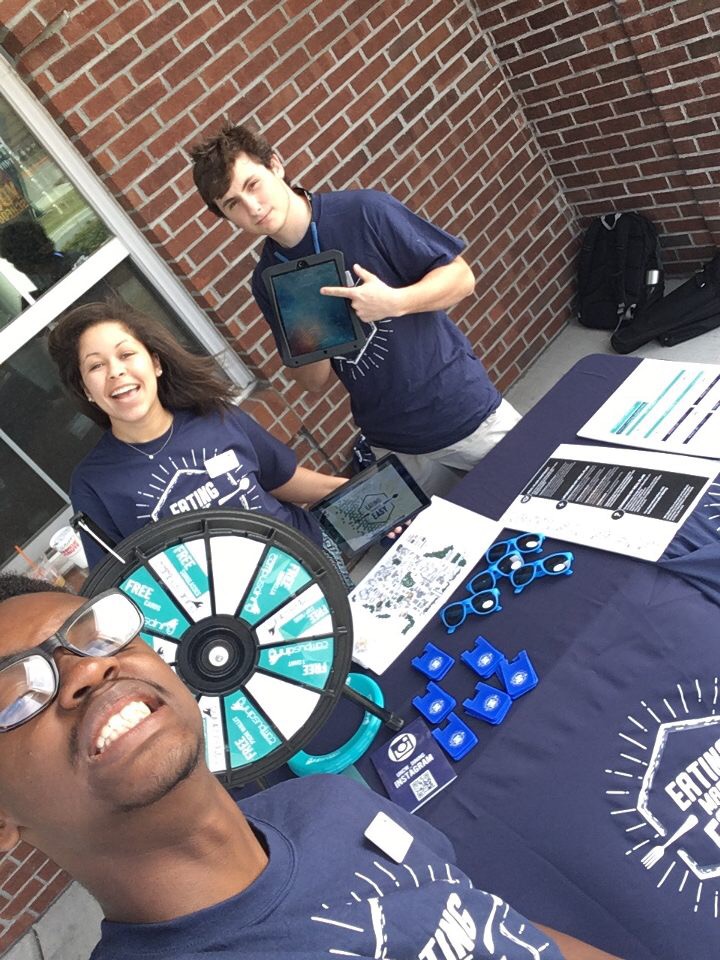
    When Katie began her freshman year in the fall of 2015, she knew she wanted to be a Communication Studies major. “I always wanted to be a sideline reporter,” Katie said. “I soon realized that I didn’t know nearly enough about sports to do that, but the major is so versatile that I figured I would still be able to find something I’d enjoy.” She started working for the UNCW Campus Dining Peer-to-Peer sales team in the fall semester of her sophomore year; she, along with a team of other students in a variety of majors, tabled around campus to inform students about their meal plan options and take surveys that fit them with their best option. This job opened up opportunities for Katie that she never expected. “I thought it would be good experience for me to get more involved with campus and meet other students. The other job I had at the time took most of my free time, so I didn’t get involved with other school activities like I had wished. But working for the Peer-to-Peer sales team gave me that opportunity to meet new people while still earning money and gaining experience with sales and marketing.”

    P2P pic

    When taking the core COM classes, it may seem like you would never use some of those skills in a real profession. It can sometimes be difficult to see how your classes would pertain to a real job in the adult-world when sitting in lecture after lecture, but gaining experience in on-campus jobs can help you see the importance of these classes. Katie goes on to say that “being able to apply the communication skills I was learning with real students in real world situations gave me a new appreciation for what I was learning. I was able to build upon my interpersonal communication skills and pick up on students’ nonverbal cues that I may have previously overlooked had I not taken these classes.”

    While Katie was just expecting to stay on the Peer-to-Peer team throughout college, a job opportunity with Auxiliary Services opened up that she couldn’t pass up. She got the position of marketing assistant about a month ago that allows her to work directly with the marketing specialist to “complete project research, develop promotional and informational materials, plan and attend public relations activities, among a variety of other activities.” Although she has only been in this position for a short time, it is something she is interested in staying in for a while. She has even started considering going to graduate school here and staying in her current position or finding a similar job within the marketing field. Katie has been able to use skills from COM classes such as 101, 200, 232, and 280 that she never thought she would use in a real-world setting, but now utilizes them every day at her new job.

    Katie headshot.jpg

    “My biggest piece of advice that I could give underclassmen is to not limit themselves. I had no desire to pursue marketing when I first started here at UNCW; I was determined to graduate and go straight into the news field. Once I opened myself up to the Peer-to-Peer sales team, I realized how much I loved working with people and being that line of communication when there’s confusion.” Katie shows us every day why being a student in the Communication Studies department is so rewarding and vital to succeeding in any job market. By embracing new ideas and gaining experience in various fields of work, you might be able to find your niche and succeed more than you ever thought possible.

  • new-piktochart_21510375_24e098ca1645ad3f83fa7a62e082a5eb49c4fc5f

    Contagious, by Jonah Berger was all about how things catch on, or become “contagious”.   The book started out by talking about a popular restaurant, Barclay Prime.  When this restaurant came about, there was almost no advertising involved, but it still became a huge and famous place to eat.  Berger begins by talking about how this restaurant became “contagious” by only word of mouth.  This made him curious about how other ideas and products spread, and how advertising and word of mouth effects what people will do and buy.

    His book was broken into six chapters which were his six principles throughout the book.

    The first was social currency.  This was all about what makes someone talk about something more than another thing, and how it spreads.

    The second was triggers.  He believes that people naturally want to keep a conversation going, so if there is a pause or break in the conversation people will be more likely to bring up an idea or product.

    Emotion was his next principle.  He believes that if someone is passionate about something, then they will be more likely to talk about that thing.

    Principle four was called public.  He states that if you see someone else doing something, you will be more likely to do that thing too.   If someone is talking about and idea or product, or doing something new, you will be more likely to want to try that idea or product for yourself.

    Practical value and stories were the last two principles.  Practical value was more on the advertising side rather than the word of mouth side.  Berger believes that if a product saves money or improves your lifestyle you will be more likely to buy that product.  Stories was the last chapter and principle that Berger spoke about.  He said that ordinary stories we tell everyday get spread, and if an idea or product is in one of those stories, people will be more likely to buy that product.

    This book was all about how ideas and products spread.  Berger did a fabulous job of incorporating his own stories and personal events in the book.  This book was a super easy and interesting read.  I would recommend it for anyone looking to spread an idea or product, or even just if you’re looking for a new book to read.

    -Jennifer Howard

  • Tips for Your Linkedin Profile

    Applying for jobs has many young adults worried. There are ways, however, to boost your chances of landing that job. Creating a Linkedin Profile is one way to show your professionalism and is a good way to network with countless other people, but you are probably thinking that many people have these profiles. How can you make yours stand out? We have some tips that you can use when crafting your profile.1217linkedin

    1. Join as Many Groups as You Can

    Linkedin allows it users to connect with others and start groups. It is important to be in groups because the more groups you are in the more likely you will be found when searched by an employer. Be sure to only join groups that are relevant to the jobs you want to get. The more groups you are a part of the more times your name your will appear in front of someone looking to hire. You can really make yourself standout by leading a group too.

    1. Be Very Descriptive in Your Summary

    The more descriptive you are in your summary the better your chances will be in attracting attention to your profile. This space allows you to tell what separates you from your peers. It is a good resource to share your story. Also, be sure to include many keywords in the “speciality” section so that when searched, your profile will show up sooner.  blog-cover-1024x587

    3. Keep it Professional

    Your Linkedin profile should be completely different than your Facebook profile. Linkedin is not a place to chat with your friends or create a profile to see how many shares or likes it can get. It is about networking and giving companies an online representation of who you are. Your profile needs to be organized. If your profile is a mess then whoever is looking at your page will assume that you are a mess too.

    1. Show off Your Worklinkedin2

    Linkedin gives its users the opportunity to attach files or link websites in the profile. It is important to utilize this so that employers have a direct link to see the work you have done. Do not be afraid to show off your work and be proud of what you have done. Remember confidence is key. Make your profile a confident one.  

    1. Keep it as Updated as Possible

    Your Linkedin profile should not be outdated. A profile is not created and then left to be alone. It should be in motion and kept up to date. Your profile needs to constantly be updated so that employers see all your experience. If you leave important information out then they will have no way of knowing of it. They can only see what you put out there. Adding that extra information could mean the difference between getting hired or getting overlooked. If you have experience then be sure to let them know. Do not limit yourself.

    Let us know what you think of our tips and be sure to comment below if you have any of your own that you would like to share!

    -Austin, Jonathan, & Kaela

    Photo Sources

     http://exclusive.multibriefs.com/images/exclusive/1217linkedin.jpg

  • Seven Years of College Down the Drain

    College. That place where mannequins come crashing through Friday night frat houses, and beer don’t cost nothing. Well, I may be thinking of Animal House, but college is like that, right? While my college experience was one of a kind, I cannot say that I have ever stolen a rump roast from the corner Piggly Wiggly. Or did I?

    animal-house-350x428

    It started like this, graduated high school with honors, got accepted into a quaint Christian college, and the rest is history. For most maybe, but not for me. While I pursued mechanical engineering and swam for the school swim team, I never felt like I was home. A semester in, I decided that college just was not for me, so I quit school to work night shift at Amazon. It was a smart plan until about a month in I realized that manual labor did not sound appeasing for the rest of my life. Jumping back into the college plan, I took some classes at the local community college to work my way back into higher education. After 3 semesters, I transferred to a place called UNCW. Although it was not my first choice at the time (#1 PSU), I welcomed the university with open arms.

    Two and a half years later, and I cannot believe that I am about to leave my home away from home. Having such a negative experience starting college, I had given up on finding the school that I could call my own.  Somehow, whether it was within my major, or the various student groups I became involved with, I now dread the day when I have to leave this home of mine. This school has given me so many opportunities to improve and better my communication skills.

    Looking forward I am excited to see where everything that I have learned, from my time at UNCW and within the COM major, will take me. Fingers crossed I end up in the brewing or automotive industry.

    Cheers to us, the class of 2015!

    o-CHEERS-LEONARDO-DICAPRIO-570

    -Joseph Hines

  • So You Want To Be A Media Planner?

    Everyday a city dweller is exposed to 5,000 advertisements. With this many advertisements it is amazing that we actually remember some of them. Part of the remembrance is due to the work of media planners.

    Media planning is the science of message dissemination. It specifically “refers to the process of selecting media time and space to disseminate advertising messages”. In order to find out more about this division and the work they do our blog group reached out to Zimmerman Advertising Assistant Media Planner Mariel Oweida.

    mariel photo

    Oweida, a May 2013 graduate of the UNCW Cameron School of Business, began working for Zimmerman Advertising in December of 2013. She referred to media planning as,

    “…finding appropriate media platforms for a client’s brand/product to use by determining the best combination of media to achieve the client’s marketing objective; media could include print, TV, radio, digital, OOH (out of home advertising- billboards, bus wraps, etc.)”

     Media planning begins with a Media Action Request (MAR) and ends with a media buy. Although the media planning division doesn’t actually negotiate the buying, they do work closely with buyers and account executives to make sure the plan is well executed.

    Media planning is fast paced. Owieda explains she was surprised at the quick turn around. Having concentrated in marketing as an undergraduate, media planning was a new career path for her. Usually you need specific degree for advertising or experience from another ad agency but, she says, ad agencies look for candidates that are willing to learn and grow with the company.

    Specifically, Zimmerman Advertising is a full-service agency that focuses on building national retail brands. Over the past 30 years it has become 14th largest advertising agency in the world and they currently bring in revenue of $100 million a year.

    zimmerman photo

    Recently they moved their headquarters to Ft. Lauderdale, FL. Their brand new office is beautifully constructed to promote a more casual, creative, and collaborative environment. Although this brand new building seems friendly and relaxed, it is full of hardworking individuals who go above and beyond to help clients meet their advertising objectives. In a previous interview with Elizabeth Harrington, Oweida described her typical workday as untypical. “You should never expect to go in at 8 a.m. or leave at 5 p.m. [You] almost always end up going in early and leaving later- that extra dedication is unpaid.”

    Zimmerman photo of building

    During her day Oweida works on budgeting clients money, conducting market research, and media placement. Already she has worked on accounts for Ashley Furniture, Boston Market and AC Moore. “The most challenging part of being an assistant media planner is paying attention to detail, executing the plan we provide, and dealing with clients,” Oweida says. “As a media planner it is your job to let clients know why they are spending their money the way you are telling them. It is important to keep up with research from Nielsen ratings, to demographics, income, and even how long people have owned homes. They all help you plan the media and explain the why to the clients.”

    So as soon to be graduates we asked for the inside scoop on what to do if you want a career as a media planner. She said work on knowing Excel and basic Excel math, but most importantly have great communication skills. She also told us to be up to date on the newest and important trends in the field, which as of right now are social and digital media.

    We would like to thank Ms. Oweida for taking the time to speak with us. If you have any questions or advice about media planning comment below!

    Caroline Robinson, Elizabeth Harrington , Savannah Valade

  • How to be the CEO of “ME” Incorporated: Personal Branding

    Every company understands the significance of branding and the role it plays in their success as a whole. Today, in the oh so competitive world of job searching and some of our, now, ambiguous futures we have to make ourselves a brand worth buying into. The thing we have to realize is that we are all worth the price that we “sell” ourselves for; each of us having different valuable brand qualities.

    The COM 400 Capstone course encourages students to write down and memorize an “elevator speech.” This is a 15-30 second rendition encompassing all of our greatest qualities that really sells ourselves to whomever we are talking with. That 30 seconds could move us from having zero job offers to having them lined up. However, in order to move forward in making this speech we must analyze ourselves and pinpoint our biggest strengths.

    This process can be started by, first, identifying all of the qualities and characteristics that make you distinctive from your competitors (a.k.a. people looking for the same job opportunities). What makes you stand out? In order to have success at self-branding you must find what makes you the zebra in a herd of horses, this is what is going to grab others attention. To start with, ask yourself: what work am I the most proud of? What do I value the most about my abilities? Etc. Asking yourself these types of questions will help you in evaluating your personal strengths and weaknesses or areas for improvement. Utilizing your strengths and highlighting them is a key component to making you stellar competition. Seth Godin states in a personal interview, “It’s all about how you can connect with people, how you can bring them up.” Your values are how you connect with others – it’s the difference of just being good to being great at what you do.

    An article from Fast Company says, “Don’t sell the steak, sell the sizzle…no matter how beefy your set of skills, no matter how tasty you have made your features – you still have to market the bejesus out of your brand – to customers, colleagues, and your virtual network of associates.” Every decision and every move you make counts. When you are branding your image people are watching your every move, just as they would in scrutiny of any other brand. Your values and character is being weighed the moment you start branding yourself. Word- of – Mouth marketing is one of the most important marketing assets you have; what people have to say about you makes all the difference.

    With that being said, once you have delivered your “Me” message and have gained the attention of others you have more than likely also obtained more confidence in yourself. This is good. However, you now have more power and more influence over others making you a leader to some. It is just as important to maintain and strengthen your brand as it is initially making it. Just as much as you are leading others, you are leading yourself. James M. Kouzes and Barry Z. Posner report in their book, The Leadership Challenge, that followers expect four things from their leaders: honesty, competence, vision and inspiration. These are qualities that lay the foundation of your brand and make you the “CEO of Me Inc.” You have potential to make your brand known and maybe even famous. You have that power, how will you use it?

    -Katelyn Alston