Category: Branding

  • Sandy Shopping Spree?

    As we watch the terrifying coverage of Hurricane Sandy hitting the Northeast, here in North Carolina we are thanking our lucky stars that we managed to escape the worst of it. However, there is one aspect about natural disasters that is challenging to escape: the advertisements. Among all of the advertisements directed towards helping those in need, there is one in particular that stands out all on its own. American Apparel, a clothing company notorious for its no-holds-bar approach to promoting their company, sent out an email blast Monday morning in an attempt to draw in online shoppers who apparently would be “bored” in the storm. This callous disregard of the life-threatening conditions that people are facing quickly went viral.

    Many people have taken to social media like Twitter and Facebook to voice their outrage at the lack of compassion American Apparel has shown for the victims of Sandy. Twitter users were quick to bring up the companies past marketing blunders including an attempt at a plus size model search.

    Needless to say, American Apparel knows how to stir things up. This advertisement was poorly worded at best, and completely ignorant at worst. Regardless, everyone is talking about the “Sandy Sale.” Is this a bad thing for American Apparel in the long run? There is a popular saying in our culture that “there is no such thing as bad publicity.” Part of what our professor, Dr. Persuit, teaches us in Integrated Marketing Communication is how to be thoughtful consumers. In order to do this, the marketing strategies American Apparel employ should have an effect on whether or not we decide to purchase their product. A year from now while you are perusing the mall and finding the perfect piece to complete your closet, will it matter if it happens to be an American Apparel item? Will this advertisement even pop into your memory or will you merely remember hearing something about American Apparel once upon a time?

    – Alexandra HussCaroline MerrillAlyssa MorrelloLauren Van TrigtDann Williams

  • Losing It All After Winning Big

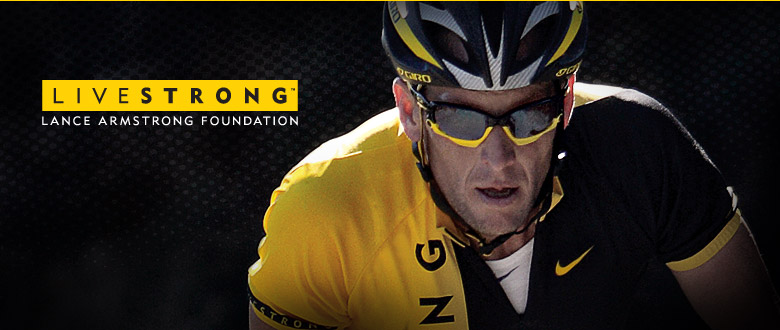
    Last week the U.S Anti-Doping Agency released a thousand page report on Lance Armstrong’s doping scandal.  The now retired cyclist hit headlines hard in late August when he was stripped of all seven of his Tour de France medals and was issued a lifetime ban from cycling. Since the story released, Armstrong’s four major lucrative sponsors have taken away their sponsorships one by one.

    Nike dropped Armstrong earlier this week due to his disgrace.  Nike released this statement “Due to the seemingly insurmountable evidence that Lance Armstrong participated in doping and misled Nike for more than a decade, it is with great sadness that we have terminated our contract with him.”

    Image

    The brewing company Anheuser-Busch also said it was ending its relationship with Armstrong when his contract expires at the end of this year.  Oakley Inc. and Radio Shack are waiting for the final decision from sport’s international authorities before conducting their final decision.  The other two sponsors that have immediately ended their relationships with Armstrong are Trek Bicycles and FRS, the energy drink maker.

    Lance Armstrong has stepped down as chairman of the Livestrong cancer support charity that he founded.  His foundation is widely known for the 70 million yellow wristbands that were distributed worldwide.  His charity raises money not for research but to help cancer survivors with employment, financial obligations, insurance problems, and access to care, especially in third world countries.

    Image

    So far, donations have increased despite the Armstrong’s scandal.  Lance Armstrong released a statement on Wednesday stating “To spare the foundation any negative effects as a result of controversy surrounding my cycling career, I will conclude my chairmanship.”

    The road for Armstrong seems far from over.  Currently, the Olympic Committee is considering taking away Armstrong’s 2000 Olympic bronze medal, which will surely endure more loss and humiliation for him.  Predictions say he will continue to lose more sponsorships and countless lawsuits will be released of breach of contract between the companies and Armstrong.

    Meaghan Beam, Jessie Butner, Zach Abramo, Jack Lane

  • To Sponsor or Not to Sponsor: That is the Question.

    Currently, one of the biggest trends in music is the presence of music festivals. These festivals host a number of bands from all different genres, pulling large audiences of varied consumers in to enjoy the shows. Festivals are generally a couple of days long and promote a laid-back lifestyle complete with camping tents and hammocks. We can thank Woodstock for this specified musical platform. However, is it also a platform for something else? In recent years, music festivals have also hosted a number of sponsors, who market their brands by simply surrounding festival goers with advertisements and products.

    But what is the benefit for companies that sponsor these events? Since companies spend time and money to become an integral part of the festival atmosphere there must be some sort of profitable gain. The major draw for companies is the audience. Generally speaking, attendees are in their late teens to late 20’s. This generational demographic, once targeted, are often very loyal consumers to their favorite brands. Companies hope to capitalize on this while festival-goers are having a good time, enjoying the music, and are open-minded. This audience is also very important because they have a larger disposable income than most. The ability to spend upwards of $400 for a two day music festival, says to companies that this demographic is, for the most part, either affluent or avid consumers.

    However, there is also a downside to being a sponsor at one of these events. Companies have to be very aware that if the audience does not perceive their product as one that coincides with the overall experience and atmosphere of the festival then they will either be completely ignored or considered an annoyance. For instance, a brewing company will do a lot better and be viewed much more positively than a law firm or insurance agency. In order to be successful as a sponsor you have to ensure that your product will enhance the mood, environment and fit the audience profile.

    One of the best examples of sponsorships working harmoniously with the specific nature of music festivals is Firefly, which was held for the first time this summer in Delaware.  Firefly made all of their vendors and sponsors local companies who brought a higher class of food and drink to the campsites. Instead of bombarding attendees with big named company sponsors Firefly chose to keep the music festival experience more authentic. Dogfish Head, their beer sponsor, even unveiled a new brew named the “Firefly Brew.” The event also had a TOMS Shoes tent, where you could purchase a pair of canvas slip-ons to be painted on-site by a local artist.

    Firefly was successful because they accompanied their musical line-ups with relevant sponsors, which in the end created a newer, more evolved and authentic version of a music festival experience.

    Lauren HabigHannah EureErin KiffmeyerAlly WaltonGene Lee

  • Anything you can do, I can do better… and cheaper!

    In the world of sports, it is never a surprise to see Gatorade as a major sponsor. Their product has been placed into events including NHL games, the MLB home run derby, and the Super Bowl. With that being said, not seeing Gatorade as one of the official sponsors of the 2012 Olympic games in London was a surprise. The reason for Gatorade’s absence in the 2012 London Games is because Powerade, a product of Coca-Cola, bought the sponsorship for over 100 million dollars and blocked Gatorade out. Gatorade did not fret when they were faced with this challenge. Instead of accepting defeat and letting Powerade run all of the sponsorships and advertising, Gatorade decided to respond with a commercial of their own.

    In this commercial, Gatorade not only openly states that they did not sponsor the 2012 Olympics, but also to spin it into an extremely effective advertising technique. They portrayed the overall message stating that they were not there on the billboards and buses, but instead they were there “for real” inside the best athletes in the world. Gatorade did an excellent job in embracing the fact that they could not officially sponsor the event, but still being present in the advertising and overall experience of the event

    In accordance, Powerade also plays an interesting role in their advertising by pointing out the fact that you may not know the athletes that they sponsor. This brings another aspect to the table that can be compared directly to Gatorade. Everyone knows the big time athletes like Derek Jeter, Tiger Woods, and Usain Bolt who are sponsored by Gatorade; but there are few people who are familiar with the athletes that Powerade sponsors. Powerade decided to base their commercial on the athletes that are not as famous, but the underdogs of the world.

    Coca-cola spent over 100 million dollars to sponsor the Olympics and Gatorade attempted to catch their audience’s attention with one commercial. The bigger the risk, the bigger the pay off, right? So what do you think… did Powerade come out ahead?

    – Alexandra Huss, Caroline Merrill, Alyssa Morrello, Lauren Van Trigt, Dann Williams

  • Has the Branding of Humans by Companies Gone Too Far?

    Marketers and advertisers have been getting more and more creative with how they choose to promote their brand and products. A recent trend has been the one of the “walking billboard.” Many people have been willing to brand almost any part of their body for the right price.


    In more recent years, tattoos have been seen as both as cultural icons as well as innovative methods to deliver a specific message. Web sites such as LeaseYourBody.com, TatAD.com, BodyBillboardz.com, HumanBanner.com, and LivingAdSpace.com connect brands and potential advertisers with individuals who are willing get “branded” for money.

    Many popular brands such as Volvo have used these creative tattoo advertisements to further promote their cars. Linda Gangeri, national advertising manager of Volvo Cars of North America, said their tattoo man was a way to get people to think differently about the Volvo brand.  Being a “walking billboard” is an extreme example of how people are being used to creatively advertise for brands in today’s society.

    There are less permanent and drastic ways in which someone can brand themselves for a company. Clothing is a great example. Clothing will always be a great tool for human branding because it is one of the first things we notice about the appearance of others.  In recent years, there have been rumors circulating that Abercrombie and Fitch pays individuals to come into their store and shop whilst wearing their clothes.  Even more recent are the allegations that the company has done the exact opposite as well. In 2011, the company reportedly offered the cast members of MTV’s “Jersey Shore”, specifically Mike “The Situation”, to not wear their clothes while filming the popular TV series. They felt that the cast members wearing their clothes affected their brand negatively rather than positively and did not want to be affiliated with the show. Clothing is also largely used by brands that are not restricted to apparel to benefit both the clothing store, and their own brand. For instance, the clothing store “Hot Topic” sells a variety of different t-shirts from many different companies. One of the big examples is the “Twilight” series. By selling shirts that relate to the book or movies, the people who buy these shirts then become walking billboards for both “Twilight” as well as “Hot Topic”. Clothing has been and remains to be a great tool for human branding for the simple fact that in society, appearance really does seem to be everything. If someone is attractive and is wearing a t-shirt that promotes something, most people that see this person are likely to be influenced by what is being advertised on the shirt.  The “Legalize Gay” shirts from “American Apparel” are a great example. Not only does the shirt promote a cause, but some people even think it’s trendy. This caused the design to become a quick success for “American Apparel”.

    Along with self-branding through choice of apparel, companies use celebrities to promote their brand by paying them a great deal of money to wear their clothes, jewelry, hats, sunglasses, etc. In 2003, famous tennis player Serena Williams signed a sponsorship contract with Nike which agreed to pay her over 8 million dollars a year just to wear Nike’s logo on her uniforms and visors while playing. Not only is Serene getting paid; she does not even have to buy her clothes from Nike because they are given to her. The better and more popular the athlete, the more money companies choose to invest into that particular person or team. Tiger Woods is another athlete that has been ridiculous sums of money just to wear and boost certain brands. Before his sex scandal, Tiger allegedly made between 55-60 million dollars from endorsements.  After, the controversy, he makes about 20 million less, but still an incredible amount of money just to wear Nike apparel.  This marketing strategy applies to fashion and luxury brands as well. On the “red carpet”, interviewers are constantly asking who designed celebrities’ dresses or what brand of jewelry are they wearing. Throughout the past couple of years, the number of film stars that accept fees for wearing a brand’s designs or jewels at the Academy Awards and other red-carpet events has significantly increased. Lucie Greene, the author of many articles located in FT Magazine, stated that “last year US Weekly reported that Oscar host Anne Hathaway was paid $750,000 by Tiffany & Co to wear its jewels throughout the ceremony. The same story said that Gwyneth Paltrow was paid $500,000 to wear Louis Vuitton baubles during her live performance” that same night of the Oscars. Businesses are looking for every possible way they can find to market their brand and increase sales and participation. Phillip Bloch, a professional stylist who works with the popular celebrity Sandra Bullock, along with many other famous clients, views this pay-to-wear trend a smart branding strategy. “It’s a business more than ever now”, Bloch says.

    Over time, the ways in which people are used to promote and essentially brand a company have evolved.  While clothing has been around for quite some time, the creative ways in which it is used has been changing in recent years.  Celebrities have been used to wear a brand and increase revenue.  As notes, extremes such as being a “walking billboard” have become more and more prominent.  As is natural in a social setting, people are extremely influential upon one another.  Thus starts the argument that as technology develops over time, the ways in which humans are used to advertise will as well.

    Sasha De Vecchi, Lindsay Gallagher, Jay Reilly, Cary Welborn

  • “The Evil Empire”

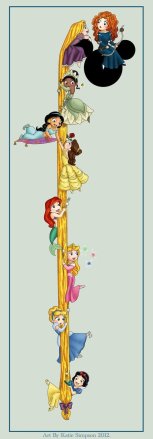
    When we were growing up, Cinderella taught us how important faith can be, Snow White taught us how important friends are, and Sleeping Beauty taught us how important following our dreams can be. However, the upcoming generation is growing up with extremely different Disney princesses than we knew. What began as the princess trifecta of Snow White, Cinderella, and Sleeping Beauty, has turned into nine princess movies all representing different images and values to the next generation of children. There is a question raised by many of whether or not the Disney princesses are teaching children the right lessons. Some have even ventured to ask: Is Disney really the evil empire?

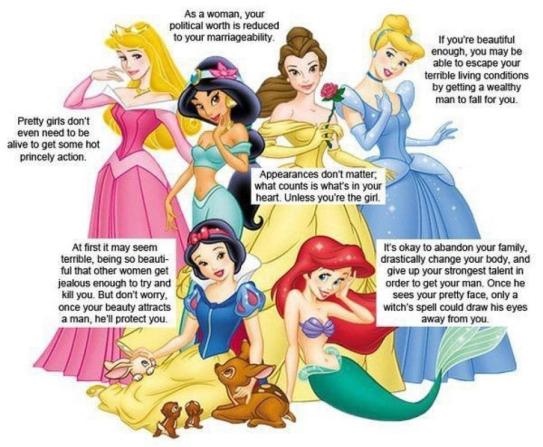
    As a brand, Disney has faced harsh criticism from the feminist movement due to the way they have portrayed women in the past. A recent meme surfacing all over the internet that de-glorifies the Disney movies from fairy tales to poor life lessons. For example, Belle is described as just a pretty face and the meme insinuates that the Beast only fell for her because of her looks. This is an oversimplification of Belle’s character as the Beast falls for her not for her looks but her intelligence, caring nature, and personality. However, the meme is not entirely wrong as not all of the early princesses are portrayed in such a dynamic manner as Belle. Cinderella and the prince barely shared a dance before they fell madly in love and Ariel ditched her entire family to marry her prince.

    In order to help manage their image, or perhaps in attempt to keep up with the times, Disney took on the challenge of making their newer princesses more dynamic and stronger female leads. Disney also released an African-American princess after receiving criticism for not having enough diversity in their fairy tale stars. An idea they really try to communicate with their new princesses is that princesses do not have to be damsels in distress. In Tangled, Rapunzel takes charge of her own life by disobeying her “mother’s” wishes. In the process, she discovers her real family and her true love. This could be seen as Disney’s ode to following your heart with more action than Cinderella took. However, the movie openly references alcohol blackouts, violence, and criminal behavior. Is this Disney trying to appeal to an older generation or avoid seeming old fashioned and out of date? Either way it wasn’t entirely in line with the identity of their prior princesses. Is this a new kind of Disney Princess we are seeing? Or a fluke straying from what Disney really represents?

    – Alexandra Huss, Caroline Merrill, Alyssa Morrello, Lauren Van Trigt, Dann Williams

  • “Saaaay Instagram!”

    Instagram is a mobile social media network. Pictures are the only content users can upload. There are no clickable links. Nor are there special types of profiles for businesses or celebrities. By doing this, Instagram has in a sense leveled the playing field. Brands, as of now, cannot pay to have their content promoted or purchase any sort of advertisements on Instagram.

    So why would a brand be interested in this? There doesn’t seem to be an advantage from a business perspective. How could a brand get the word out about their Instagram without being able to promote within the network? This is where the share ability on Instagram comes into play. Instagram users have the ability to share their Instagram posts on Twitter, Facebook, Tumblr, Flickr, and Foursqaure. Additionally, brands can use relevant hashtags on their pictures to draw Instagram users who may be interested in what they are Instagramming to their business account.

    Now that it is clear how a brand could draw traffic to their Instagram, it is interesting to look at the content brands post on Instagram and how these posts contribute to their brand identity. The content of the posts will vary on the type of brand and each brand’s individual needs. For example, Taylor Swift utilizes Instagram as a way to communicate her thanks to her fans and visually share parts of her life with them. Many celebrities use Instagram in this manner. It is effective in helping fans see celebrities as relatable people, and makes them seem less out of touch with the everyday reality.

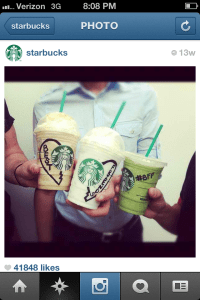
    Larger brands can also use Instagram in a variety of ways. Two of the largest brand accounts on Instagram offer an interesting comparison. Starbucks uses pictures taken of their products by customers that hashtag pictures with “#starbucks.” MTV takes pictures of celebrity visitors, backstage/onstage at awards shows, newly released videos or singles… anything that is happening at MTV is pretty much free game. Is one better than the other? The answer lies in brand identity. Starbucks strives to make a heartfelt connection with their customer base, while MTV relies on sparking their customers interest with the celebrity factor. For Starbucks, trying to make a heartfelt connection works. While they are an international chain, as a brand Starbucks wants to keep that feeling of the neighborhood coffee shop alive yet still provide consistent products globally. By highlighting the existing Starbucks customer base, the brand still appears personal.  MTV takes another route by using Instagram to revive their brand identity of music television. The majority of their Instagram is focused on new songs, videos, and musician sightings. This is a major change from their actual televised programming which ranges from scripted shows such as, Awkward. to reality shows such as the infamous Jersey Shore. By using their Instagram to focus on their musical brand identity, MTV is returning to their roots. Instagram is a way to appease the viewers who prefer the old MTV without all of the television shows.

    Whether it be your average individual using a filter to feel artsy or avid Starbucks drinkers expressing their love for a drink, this social networking site is creating a sense of community through a few simple taps on your smartphone. Brands can use this sense of community to make their customers feel more in touch with their products. Try scrolling down Starbucks’ Instagram feed without having your mouth water! Now where’s my Pumpkin Spice Latte?!

    – Alexandra Huss, Caroline Merrill, Alyssa Morrello, Lauren Van Trigt, Dann Williams