Category: Branding

  • Target Hits Bullseye With Brilliant Idea

    A company that can take the hassle out of back to school shopping is a company that has definitely won our vote and our business as customers. The days when back to school shopping was fun for us are long gone to say the least. For some reason, the thought of getting every color crayon that Crayola made or digging through piles to find the cutest lunch box, are not as enticing as they were in the past.  Back to school shopping as a college student is now viewed as a huge inconvenience. Over-crowded stores, lines a mile long, and over-aggressive parents that feel the need to bulldoze their way down the book bag isle are usually reasons to steer clear of any store on back to school weekend.

    Screen shot 2013-09-11 at 7.08.31 PM

    The Target in Wilmington, North Carolina has taken these pains into consideration and concluded that something needs to be done. This year Target partnered up with UNCW to take the stress of back to school shopping off of students. Advertised on UNCW’s website was a night where Target devoted its store exclusively to UNCW student shoppers. On August 18th, Target had a shuttle running a continuous 20-minute loop from 10pm to 1am transporting students to and from UNCW’s campus to Target’s New Centre location.

    This is a brilliant marketing plan. Target is a company that knows its consumers and pays close attention to their wants and needs. College students are not wanting to devote an entire day to going from store to store in an effort to find all of the items on their shopping list. And even those that do, the goal is to get in and get out as fast as possible. By opening the store late at night for college students, Target was aware that students would be more inclined to taking their time browsing the store and seeing what all they could purchase for their dorm or apartment. This plan was likely to make Target more money than if students were to be overwhelmed with people and having the “in and out” philosophy.

    Target has once again put themselves ahead of the curve and made it exponentially harder for competitors to compete with their brand. Known for being a more high-end store, Target has taken back to school shopping to the next level and to the most profitable target market imaginable. College students ranging from 18-24 are known for impulsive buys and back to school is just the time to boost their sales. They have taken their ideal market and closed off the store specifically for them. Many new students coming to college do not have the luxury of owning a car or having their family living close by and this can become troublesome when trying to make those back to school purchases. The fact that Target has taken this into consideration when shuttling students not only tells you about them as a company but gives you an idea of the loyalty they have for their customers.

    They then took this a step further and went beyond your everyday college student. Target gave kids living under the poverty line in Wilmington a chance to stock up on new supplies, clothes and necessities for the new school year. This says a significant amount about Target as a brand. Not only do they strive to meet the needs of college students in Wilmington, but as a community they want everyone to have an equal chance for success in the upcoming academic year. This makes us love Target even more. As as a consumer and college student it definitely makes us proud to shop there.

    -Kaitlin Batson, Alex Corrigan, Parker Farfour, Caitlin Ford

  • How to be the CEO of “ME” Incorporated: Personal Branding

    Every company understands the significance of branding and the role it plays in their success as a whole. Today, in the oh so competitive world of job searching and some of our, now, ambiguous futures we have to make ourselves a brand worth buying into. The thing we have to realize is that we are all worth the price that we “sell” ourselves for; each of us having different valuable brand qualities.

    The COM 400 Capstone course encourages students to write down and memorize an “elevator speech.” This is a 15-30 second rendition encompassing all of our greatest qualities that really sells ourselves to whomever we are talking with. That 30 seconds could move us from having zero job offers to having them lined up. However, in order to move forward in making this speech we must analyze ourselves and pinpoint our biggest strengths.

    This process can be started by, first, identifying all of the qualities and characteristics that make you distinctive from your competitors (a.k.a. people looking for the same job opportunities). What makes you stand out? In order to have success at self-branding you must find what makes you the zebra in a herd of horses, this is what is going to grab others attention. To start with, ask yourself: what work am I the most proud of? What do I value the most about my abilities? Etc. Asking yourself these types of questions will help you in evaluating your personal strengths and weaknesses or areas for improvement. Utilizing your strengths and highlighting them is a key component to making you stellar competition. Seth Godin states in a personal interview, “It’s all about how you can connect with people, how you can bring them up.” Your values are how you connect with others – it’s the difference of just being good to being great at what you do.

    An article from Fast Company says, “Don’t sell the steak, sell the sizzle…no matter how beefy your set of skills, no matter how tasty you have made your features – you still have to market the bejesus out of your brand – to customers, colleagues, and your virtual network of associates.” Every decision and every move you make counts. When you are branding your image people are watching your every move, just as they would in scrutiny of any other brand. Your values and character is being weighed the moment you start branding yourself. Word- of – Mouth marketing is one of the most important marketing assets you have; what people have to say about you makes all the difference.

    With that being said, once you have delivered your “Me” message and have gained the attention of others you have more than likely also obtained more confidence in yourself. This is good. However, you now have more power and more influence over others making you a leader to some. It is just as important to maintain and strengthen your brand as it is initially making it. Just as much as you are leading others, you are leading yourself. James M. Kouzes and Barry Z. Posner report in their book, The Leadership Challenge, that followers expect four things from their leaders: honesty, competence, vision and inspiration. These are qualities that lay the foundation of your brand and make you the “CEO of Me Inc.” You have potential to make your brand known and maybe even famous. You have that power, how will you use it?

    -Katelyn Alston

  • Creating an Online Portfolio

    The end of the semester is near and graduation is right around the corner! Seniors are now pressured to lock down future plans for the next chapter of their lives. Whether your goal is starting a career, an internship, or graduate school, this is a very important time to mold your brand and prove your worth. The image you portray is vital, you need to market yourself in a way that is unique and shows that you will be an important asset to the team.  Thanks to our Communication Capstone course, students can prepare and shape their resume and artifacts for their portfolios. Why not make an online portfolio? In this day and age, in almost every field an online presence is essential. I am going to show some advantages of making your own online portfolio.

    As we all know, the moment an employer decides someone is worth hiring, they Google the prospect to gather as much information as possible. Facebook, Twitter and other social media is a great way for an employer to size someone up. But, if your online portfolio is the first thing the employer sees this can be beneficial to you by making you appear professional while showcasing your work. It shows employers you have taken the time and initiative to collect artifacts such as past articles, blogs, projects and presentations. Online portfolios give you the opportunity to show the steps and improvements you have made within projects. Including future goals is something that employers would like to see as well.

    The ability to personalize the layout and design gives you the opportunity to perfect your brand image exactly how you would like to present yourself.  Maggie O’Briant’s article, 5 Great Online Portfolio Hosting Websites, claims that carbonmade, behance, photoshelter, dripbook, and viewbook are all great opinions when choosing the host site that is right for you. Maggie also describes the details of each of these listed sites in her article if you would like more information.

    carbonmade_one

    An online portfolio is the ideal tool to create brand coherence for yourself.  In the book Branded Nation, James B. Twitchell defines brand coherence as “a sense of coherence, a sense that nothing was out of place, a sense of a center”. This will give your audience a clear image and a centered sense of who you are. The best part is you have the ability to control your image, by editing your portfolio at anytime. Twitchell also states that a brand tells a story. Creating this profile offers you a platform to display the story of YOU, how you have evolved, and where you would like to go.

    – Kelsey Raskob

  • The Transparency Angle

    What’s even real these days? It may or may not be a question that’s crossed your mind recently, but it is causing a stir in companies and ad agencies.  Transparency and authenticity are in, and flashy propaganda is on its way out.  It’s no surprise that businesses continue to refine the concept of authenticity for the purpose of marketing strategy.  What could be more lucrative than to convince consumers that a product can bridge the disconnect between modern civilization and reality, especially in a society constantly seeking meaning?

    Chick-fil-A is one company that is now taking the advertising approach of transparency, inviting customers for behind-the-counter tours at all of their locations.  This blazes the path for their upcoming menu improvements, such as salads with more nutrient-rich ingredients focused on harnessing the concept of authenticity in their food offerings.

    However, restaurant chains aren’t the only ones using this strategy.  Dove, a brand owned by Unilever, started the “real beauty” campaign in 2004 in the hopes of expanding the definition of beauty and promoting self-esteem in women of all shapes and sizes.  This week the company released a video to tell women “you’re more beautiful than you think” by comparing how women view their own beauty with how strangers view them.  This type of advertising goes beyond showing the consumer how authentic a product is; it makes the audience consider the authenticity behind their own self-image.

    The Authenticity Hoax, a book by Andrew Potter, takes apart the ideal of the “authenticity” that we’re all striving for.  He looks at the areas of our lives where we feel connected to experiences, the world, and nature, and how society has lost the true meaning of authenticity in the process of seeking it out.  In his conclusion he says, “we are trying to find at least one sliver of the world, one fragment of experience, that is innocent, spontaneous, genuine, and creative, and not tainted by commercialization, calculation, and self-interest.”

    The minute authenticity became a brand in and of itself, people wanted to have it, and companies are more than happy to sell it.  Dove may highlight the reality of the average woman versus the size zero models in many other ads, but that doesn’t mean they’re not capitalizing on some other ideal.  Authenticity is the new thing to have.  The problem is, just as Potter points out, authenticity is pretty much a false goal.  Chick-fil-A can show its customers where they make the food, but that doesn’t mean anyone’s life is more real because they ate a chicken sandwich that wasn’t frozen.

    Ally Walton

  • Advertising Pranksters FOOL Consumers

    Bacon flavored mouthwash, lunchmeat DVDs, and glass-bottom airplanes?? This year’s April Fools holiday has caused an eruption of many brands’ foolish pranks going viral on social media. Some brands have even gone as far as creating spoof commercials and print ads along with their playful posts and tweets.

    For example, the P&G brand, “Scope” ran an ad on Facebook promoting their new “Bacon Flavored Mouthwash.” As you can see below, the company created a video spoof and several advertisements with catch phrases such as “Taste breakfast while washing it away” to promote this fictitious new product before they came out with the final phrase, “APRIL FOOLS!”

    Another brand having fun with this holiday is the movie rental company, Red Box, who is advertising “Sandwiches at Redbox.”

    To keep up with their April Fools promotional efforts, Red Box noted that they will be offering 50 cents off their rentals today only by entering the promo code “APRILFOOLS.”

    Virgin Atlantic Airways founder Richard Branson fooled customers in his blog featuring a new “glass-bottom airplane.” (Not for those afraid of heights!)

    The main reason marketers have chosen to embrace April Fools Day pranks is to make consumers laugh and create a lasting impression. However, these advertising pranksters may have another prerogative: by playing April Fools jokes via social media, these brands have the opportunity to go viral and target the new generation of social media natives.

    I think this is a smart tactic for advertisers as it shows that they can poke fun at themselves while promoting a playful culture that consumers can enjoy. Furthermore, as these spoofs go viral, they are gaining more traffic to their company webpages where actual products can be marketed and sold.

    Daniel Kahneman, author of Thinking Fast and Slow introduces the idea that our minds are associative machines where there are two systems at work. While advertisers may be promoting fictitious products to fool consumers, they are also taking advantage of our associative minds. By being playful and enjoying the holiday, consumers may associate these brands with being lighthearted and fun, further promoting a positive brand image.

    All in all, these April Fools pranksters have the right idea: using humor in advertising and focusing on building relationships with consumers should lead to a more positive brand image and (hopefully) increasing sales!

    Julia Tompkins

  • Reaching New Heights in Creativity

    How many billboards do you take notice to on your daily commute? I honestly could not recall the last one I saw or what it was promoting. I am sure I am not alone in this realization. These strategic advertisements are lined down the highway like dominoes, yet many do not even double take to see what they have to offer. That is the point, right? To be noticed? I am sure that advertisers do not spend thousands of dollars on outdoor advertising just to have it passed by without a second thought. However, surprisingly 71% of drivers notice billboard ads according to an article entitled The Strange Impact of Billboard Advertising. With that being said, agencies have some ammunition for their brands if executed correctly. Even though we may not remember every advertisement we pass, we are subconsciously taking it in. The challenge is to effectively present your brand so that they work as effectively as they are intended to. Here are a few that are quite bold and competitive:

    Okay, so we know, statistically speaking, they work well but the question is: what makes billboard advertising effective enough? The whole purpose in this choice of advertising is not to be informative, I mean we only have about 4 seconds in the drive by to take it all in, but rather to create a lasting impression of the brand. Stephen Littlejohn puts it well in his textbook on “Theories of Communication.” In chapter 7 he discusses the idea of ‘Message Reception and Processing.’ This theory implies that a communicator has 2 levels of intent: informative intention and communicative intention. Informative intention hopes that the audience is made aware of something and communicative intention being that the audience realizes the purpose of it. That is the goal with outdoor advertising. Within a matter of seconds the viewer should be visually made aware of the brand or product. Then, the advertiser has hopes that they made a big enough statement that they remember the brand, even if it is triggered in the depth of our sub-conscious somehow.

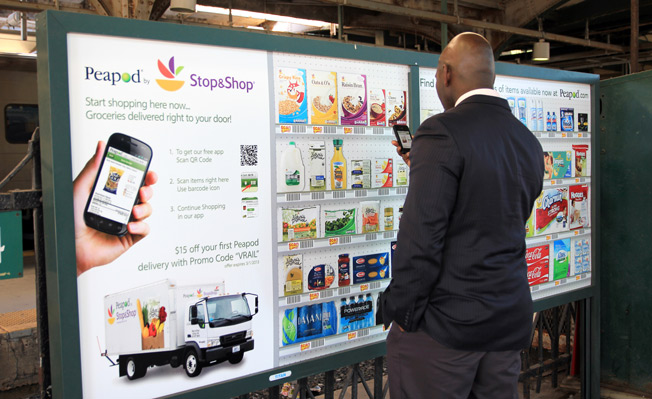
    What does this mean for advertising? In order to make the impression on people that they hope for, advertisers have to aim to be engaging, bold and informative all at the same time. The brands and products are resting on a visual representation…telling a story. Some of the ones seen today have accomplished just that and have been very beneficial to maintaining their brand names.  For example, the creative “Peapod” allows those on foot to access an interactive screen when they need to complete a quick grocery shop. Shopping on the go has never been easier. Image

    The target audience for this display is those who lead busy lifestyles and don’t permit much time to complete daily necessities. This type of shopping is entertaining and even seems enjoyable. The user-friendly screen only requires a smartphone, the free ‘Peapod’ app, and a quick wave over the bar code to scan the image above it. Instant groceries are right there, only a scan away.

    Needless to say, advertising is making some huge improvements in their promotion of products via billboard ads. The article 40 Absolutely Brilliant Billboard Ads displays images of some of the most recently developed billboards which have been highly effective.It seems that Outdoor Advertising is finally reaching new heights in creative presentation, communicating to the public that they are something worth looking at!

    -Katelyn Alston

  • “Checking In” to Spring Break

    Happy Spring Break! Many students have spent the last couple months (or longer) trying to figure out where their Spring Break time is best spent. If you’re like me, this preparation may have involved a thorough internet search to find the perfect hotel for your week off. An increasing number of hotel chains have discovered the perks of social media use and are developing ways to satisfy the needs and wants of their customers on an increasingly personal level.

    Social media sites such as Foursquare, Twitter and Facebook Places, allow a user to “check in” or log their current location. While some companies may be skeptical about the relevance of such tools to the business that they do, the hotel industry has discovered that these services create a greater feeling of inclusion and personalization to their guests. Now hotels can invite guests to “check in” both literally and virtually, completely committing to their stay. Another added benefit of location-based check-in tools is the ability to track and incentivize a guest’s stay. Hotels participating in incentive programs for social media have been known to use a variety of rewards to reach out to their social media circle; examples include anything from a discounted meal in the hotel restaurant to late checkout times for the final night of your stay. Some hotels have gone so far as to collaborate with airlines or credit card companies to create an unofficial “rewards program”; offering discounts and frequent flier miles for using your American Express card or staying at the Hilton.

    Of course with programs such as these, there can (and will) arise questions of security and privacy. Many savvy social media users are hesitant to place their exact location online. The flip side of this is that many users don’t want the world to know where they are NOT (for instance at home…protecting their belongings). While safety and security concerns are understandable, potential thieves and “bad guys” are not the only party with a vested interest in your location and personal information. Some of the aforementioned hotels have begun tracking mentions of their brand to create a more customized experience. For instance, say you book a night at a Marriott and tweet about how excited you are to stay there for your anniversary. With the use of these tools it’s not unlikely that you will open the door to find a chilled bottle of Champagne with a note from the staff wishing you a “Happy Anniversary”. Or, on a creepier note, a woman on the local radio the other day described checking into a hotel to find a wrapped dog bone and a note saying “Snickers misses you”, a response to her Facebook status the day before where she stated that she “ hate(s) to leave Snickers (her dog) at home when she goes on vacation”… To me, this was a little bit too personalized.

    As is typical with this type of marketing, it is necessary to find a happy medium between discovering a guest’s needs and invading their privacy. How far is too far and is there such thing as too personal? While this may not be a topic that concerns you too much while lounging on the beach in Florida or soaking up the culture in a foreign country, it’s important to keep in mind that while logging your location, you may be signing up for more than you recognize. So what do you think? Will you be
    “checking in” before you checkout this Spring Break?

    Lauren Habig