Category: Branding

  • Tackling Consumers

    A round of applause for the Seattle Seahawks as the champions of the Super Bowl XLVIII. Even if you were not a fan of either the Broncos or the Seahawks, it almost a sure bet you tuned into the game. Every year over 100 million people observe what is arguably the sporting event of the year.

    The Super Bowl, however, is known for more than a fierce round of football – it’s known for the commercials. Here is time where advertisers pull out all the stops. Audiences expect commercials of both artistic and humorous grandeur. Prices for spots annually rise, this year topping at $4 million for a 30 second spot.

    Yet companies don’t spend millions for spots merely to entertain viewers. Unlike in decades past, advertisers are no longer in the business of explaining, but in the business of convincing and reinforcing. This is often the purpose of commercials we see every day. So, other than the guaranteed viewership, what is the worth of a Super Bowl spot?

    Credibility, claims Joe Glennon, assistant professor of advertising at Temple’s School of Media and Mass Communication. In an article for the Philadelphia Business Journal, Glennon explains that many advertisers walk away from the exorbitant price tag due to the simple financial standpoint that $4 million for 30 seconds is a largely impossible return on investment. He explains that of those who do justify the expense there are two primary advertisers – large, well known, companies who use the spots to reinforce brand propensities among current users, and smaller companies who use the spot as a means to launch into the market by gaining notoriety.

    So, in the myriad of last night’s entertainment, we have selected four commercials that beautifully represent the two credibility building categories Glennon noted; some attempting cut into, or further into the market, others reinforcing brand attitudes.

    Squarespace

    Squarespace created a spot that was a humorous, but accurate depiction of what the Internet is like – cluttered. Personifying memes, obnoxious advertisements, and the “duck face”, Squarespace offered to consumers that when using their services for website building and maintenance, the company could alleviate such distraction. So, why did Squarespace make it onto the list today? Simple, the Squarespace commercial introduced the company values and brand in a creative, weird, funny, and somewhat true way. Justifying the $4 million dollar expenditure seems to working so far – we are talking about – there’s probably a good chance other people are too.

    WeatherTech

    Although the ad was neither humorous nor heart-warming, WeatherTech’s commercial built on a sacred theme in the Super Bowl: American pride. Their slogan, “American Factories, American Raw Materials, and American Workers”, was enough to draw people’s interest and introduce their company as a defying the odds, sticking with their gut, and overcoming obstacles many American companies have faced. During a time when many gripe about US jobs becoming outsourced, it’s hard to say that WeatherTech didn’t prove their credibility with their national pride.

    Cheerios

    Yes, the adorable little girl is back and this time she is getting a brother. This 30-second ad wraps up what all of us remember of Cheerios and what the Cheerios brand wants us to remember about them; families coming together over love. Here Cheerios is showing how they are continuing to be a hearty and healthy part of growing families.

    Bank of America/(RED)/U2

    What does this commercial not do? It introduces U2’s new song “Invisible” (there is still time to get your free download if you haven’t done it), it highlights and raises money for the charity (RED), increases knowledge of AIDS/HIV, and shows Bank of America’s humanitarian efforts. Reinforcing their slogan, “Life is better when your connected”, Bank of America is giving a chance for its customers and the world to connect by helping to end an epidemic.

    What is your opinion? Do you think these commercials deserve a spot in these categories? What other commercials did you see that introduce the brand or reinforce existing brand propensities?
    Caroline Robinson, Savannah Valade

  • You can’t have your Coke and drink it too

    It’s one of the pillars of successful marketing, target your audience. Individualizing ads to particulars groups or regions of consumers ensure that messages have the most impact. But what happens when a company features a controversial scene in a spot, then removes it for some audiences and not others? Good marketing move or failure to take a stance?

    In its newest global campaign, “Reasons to Believe” Coca-Cola set out to inspire consumers that no matter what happens in life, it’s those small happy moments that make life worth living.

    Check out the commercial below.

    In most European countries the ad contains a scene of two gay men holding hands in front of their wedding party. However, in the Irish version (the video below) the scene has been replaced to feature a bride and groom.

    The Irish LGBT publication, EILE Magazine, brought attention to the issue, calling the removal an “inexplicable move”. In response to the criticism, Coca-Cola said that the advertisement had been tailored to individual markets so that the ad resonates with the people in each country where it is shown. The company defends the decisions saying that grooms were excluded from the Irish version because gay marriage is not legal in the country. EILE Magazine claims the Coca-Cola reasoning moot. The footage of the two grooms is known to be a video clip from a same-sex union ceremony in Australia – equivalent to a civil partnership in Ireland. Yet gay marriage is also illegal in Australia, but shown there. EILE claims the spot should have been suitable for Ireland as well.

    Coca-Cola has unequivocally made public their supporting stance on same sex marriage. Since 2006, the Human Rights Campaign continues to award Coca-Cola with a 100 percent ranking of their company polices and practices regarding LGBT. The Coca-Cola Company notes on their website, “To achieve a perfect score, companies must have fully inclusive equal employment opportunity policies, provide equal employment benefits, demonstrate their commitment to equality publicly and exercise responsible citizenship”

    Many are saying that Coca-Cola’s recent actions were hypocritical. Coca-Cola claims to support gay marriage, but their choice to remove a gay marriage scene from a commercial in Ireland, in which law does not prohibit such imagery, is misleading of the company’s values. Similarly, another beverage icon, Starbucks, has also gained attention for their hypocritical actions.

    Bryant Simon discusses the company Starbucks in his book Everything But the Coffee. Through his research he comes to discover that Starbucks isn’t delivering what they are promising in their brand – good coffee with little environmental impact. Claiming to buy fair-trade coffee from Rwanda and Nicaragua farmers, Starbucks was actually buying from bigger farmers and only buying 5-6 percent of fair-trade out of all the total coffee purchases.

    Much like Starbucks claiming to be environmentally friendly yet not taking the necessary steps in order to be green, Coca-Cola’s actions were just as misleading; claiming to support gay marriage yet removing a scene from one version of a commercial for the sole purpose of trying to please everyone.

    As future and current brand ambassadors we have to remember that every decision we make, including company policy decisions, become an integral part of brand, and when decisions are made that contradicts that it hurts the brand.

    On the other side of things, as consumers (and as Simon states in his book) we have to remember pursuing “solutions to highly complex social problems through buying and buying alone” doesn’t fix the problem or change the ideology. We have to stop relying and believing that buying certain brands is going to change a social issue.

    So, does Coke’s decision to take out the gay marriage scene hurt its brand identity? Should companies take stances on social issues? What practices do you follow to make sure this brand conflict doesn’t occur in your company or with your clients?

    Savannah Valade, Caroline Robinson, Elizabeth Harrington

  • Towels For Troops: Supporting Our Heroes

    I cannot speak for others, but one of the most quickly used products in my household is paper towels. Often times, it seems that they have to be bought on a weekly basis. Thankfully, Brawny, the paper towel company, recognized the necessity that paper towels have become and leveraged their product to help out a worthy cause.

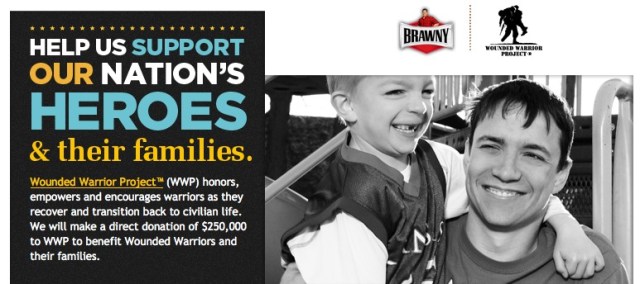
    Last year, Brawny partnered with the Wounded Warriors Project to launch an “Inner Strength” campaign. For two years, Brawny has prided itself on standing strong alongside the Wounded Warrior Project (WWP) as a means of honoring injured service members. In 2012 alone, Brawny raised more than $500,000 for the WWP.

    hahahahaha

    For those of you who are unaware of the Wounded Warriors Project, it is a form of charitable support for members of the armed forces who were injured in the line of duty. Donations made to WWP help thousands of wounded warriors and their families as they return home from current conflicts.

    With great success, Brawny decided to continue this cause marketing initiative committing to raise $600,000 this year. As a means of accomplishing this goal, Brawny has promised to make a direct donation of $250,000 to benefit the WWP. They have also announced their pledge to donate an additional $1, up to $350,000 for every individual who: shares a “Thank You” note on the Brawny Facebook page, “likes” Brawny paper towels on Facebook, or texts THANKS to 272969.

    Large goals like this are often hard to achieve, but worth it when it comes to a good cause. In the study of rhetorical theory, Greek philosopher, Aristotle teaches the three modes of persuasion: ethos, pathos, and logos. In this example, Brawny is able to use cause marketing to appeal to pathos or the emotion of the audience, but this tactic is commonly used in cause marketing. Pathos is the strongest mode of persuasion; making it a more frequently used appeal.

    Personally, when I hear the word “persuasion” I immediately make the connection to an interchangeable and more frequently used term…Influences. Persuasion is a process directed towards changing or influencing people’s beliefs, attitudes, and intentions. Individuals are persuaded each and every day. Persuasion is a critical and underlying goal of all marketing and advertising efforts.

    The “Inner Strength” campaign is an effective form of cause marketing conducted by Brawny and the WWP. This particular campaign does an efficient job of persuading customers purchasing decisions by appealing to the audiences’ emotions. Customers are much more inclined to buy a product if they know that it is for a good cause.  It is that simple.

    In this case, customers are buying Brawny products because it is to their understanding that a percentage of the proceeds go to the WWP. This is because these consumers feel a sense of sympathy for wounded soldiers. This is a form of persuasion at its finest. Ultimately, cause marketing has proven to pay off in this scenario seeing how Brawny sales are through the roof and donations made to the WWP are at an all-time high

    Happy Thanksgiving!

    -Caitlin Ford, Parker Farfour, Alex Corrigan, Kaitlyn Batson

  • Paul McCartney’s NEW Publicity Stunt

    The digital world of iTunes and social media has given the music industry both high and low notes. While the Internet offers accessibility, it also caters to specificity. Most predominantly, the Internet offers an array of platforms for artists to upload, share, and send their music.  However, while music junkies may be constantly searching for new digs, most people eventually acquire a particular taste for what they choose to send through their ear buds.  Internet music services such as Pandora, Spotify, and iHeartRadio allow users to handpick and listen to an endless variety of artists and genres. This narrowcasting of music leaves artists waging campaigns to try to reach listeners. As a result, clutter prevails.

    Like in advertising, clutter has become a big problem in music promotion. As Douglas Rushkoff pointed out in The Persuaders, “The more messages they create, the more they have to create to reach us.”

    The more opportunity social media platforms – YouTube, MySpace Music, and most recently Vine – offer artist to share their music, the more competitive and important promotion of music and musician become.

    So how does a music artist break through all the online music clutter without breaking budget? The answer is: great music, a little luck, and a publicity stunt.

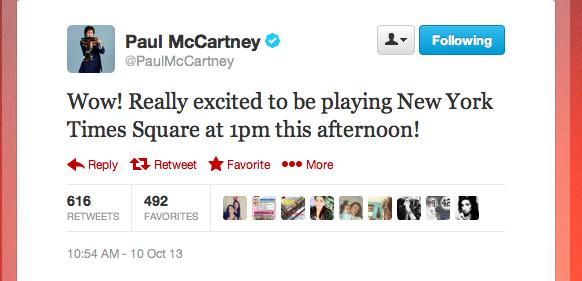
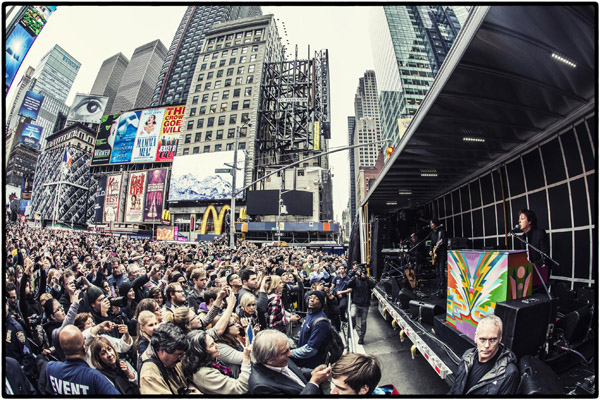
    Not new to the music arena are surprise gigs on rooftops or buses in the middle of big cities, events known in the public relations world as a publicity stunts. This past October, music legend Sir Paul McCartney promoted his recently released album, NEW, by doing just such a thing – performing a surprise concert in the middle of Times Square.

    Paul McCartney at performs at the Times SquareTelling fans only hours before – via Twitter – he played a 15-minute long show featuring the single “New”, as well as music from the (not at the time released) album. McCartney was not only able to give NYC fans a concert, but fans from around the world could tune in through Times Square live webcast and watch the performance.

    pm tweet nyThe surprise gig resulted in social media buzz and major news coverage, all promoting the NEW album for free. The stunt was so successful; exactly a week later he performed another surprise concert in London.

    pm tweet loSir Paul McCartney proved how to conquer the masses. Not only did he succeed in making his fans happy, but also he succeeded in executing a publicity stunt that generated both word of mouth and media coverage that ended up promoting his music at no cost to him.

    Caroline Robinson, Savannah Valade 

  • Training Fresh with Subway

    Athletes today are not only known for their moment of fame on the big screen during game day, but also, for their many appearances endorsing popular products, brands, and, restaurants. Subway is a restaurant chain not only known for their popular array of sandwiches, but, also for the many athletic spokespeople that work to promote their healthy food options. Surpassing McDonald’s in number of worldwide restaurants, Subway is most definitely a force to be reckoned with in the fast food industry.

    Being so high on the fast food chain, a restaurant of such magnitude wants only the best to represent their brand. This is why Subway has chosen to use well-known athletes as celebrity endorsements. They have been quick to snag star athletes from a plethora of sports and now appear to be greatly reaping the benefits of their decisions, but, why? How do these athletes help encourage everyday consumers to eat Subway? Easy!

    Subway prides themselves on being able to partner with big name athletes such as Nastia Liukin, Michael Phelps, Robert Griffin III and Apolo Ohno, but, they did not pick these celebrities at random. According to Tony Pace, SVP and global CMO of Subway “We choose fans of Subway who just happen to be famous.”

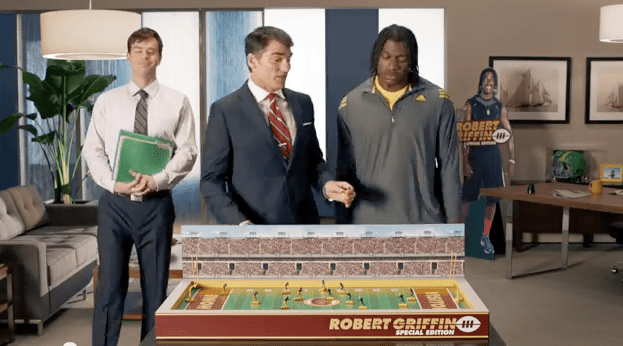
    One of Subway’s newest marketing campaigns utilizes their celebrity endorsements by asking them the simple question; what’s your favorite Subway sandwich? Each athletes answer can be found on the Subway website under the “Famous Fans” tab.

    sub

    The page includes a brief description of each of their fourteen supporters alongside the name of their favorite sandwich. Subway’s slogan is, “Subway, the official training restaurant of athletes everywhere.” This goes hand in hand with their promotion of healthy eating and low-calorie sandwich options. Yet still, many want to know why just the sight of their website or viewing of a thirty-second commercial clip makes us want to eat Subway.

    It has to do with the attribution theory, studied in many communication and psychology classes. Viewers of Subway commercials see famous celebrity athletes supporting Subway and attribute their success to Subway and its healthy sandwich options. One of Subway’s newest commercials features the famous Washington Redskin’s quarterback, Robert Griffin III, better known as RG3. Throughout the commercial the narrator makes Comments such as, “RG3 trains hard and smart with low-fat protein-rich turkey breast” and “RG3 always scores with his fav, Subway turkey breast with spinach and tomatoes.” This creates an automatic correlation in the mind of consumers between the success of Robert Griffin III and his decision to eat at Subway.

    RG3

    As we continue to see RG3 and other athletes on Subway commercials, and hear about all of their many accomplishments, we will most likely continue to choose Subway as a top fast food restaurant. I mean, who else wants to eat at the same restaurant as Jarvis Jones, Mike Trout, and Carl Edwards? We do! This healthy promotion is one that has everyone giving Subway two thumbs up and a stamp of approval.

    -Caitlin Ford, Kaitlin Bateson, Parker Farfour, Alex Corrigan

  • Name Changer

    Tailgating, body paint, jerseys, good luck rituals, and an unparalleled fraternity all exist as part of sports fandom. People love their teams – and love anyone else who also loves their team. Such loyalty has become an integrated part of sports culture sociology.

    Social Identity Theory states that by wearing team colors, attending games, knowing the players’ names, positions and stats, a fan begins to feel as if they are an integral part of the team – they connect with the team as if they were playing the game themselves. This connection explains why even poor performing teams have avid supporters. However, it is ultimately marketing that fosters fan identity. After all teams are brands; encompassing colors, logos, and mascots.

    fans, blog 3

    Fan loyalty has elevated sports to become part of our commodity culture; a product to be bought and sold, meaning big bucks for team owners. High-level sport has been transformed into a commercialized, commodified, and massified phenomenon. Therefore, fan identification and brand commitment become two key factors in managing and marketing a team. Building a brand is hard, but building and maintaining a culture of fans is much harder.

    As we transition into fall, we know that means one thing in sports,  football is king. With the NFL season in bloom, one team in particular, the Washington Redskins, are off to a rough start. The return of RG III has been very anti-climactic and on top of the team’s poor performance, a greater worry looms in the background: the franchise is under pressure to change the team name.

    Many believe the team’s name, “redskins”, is derogatory and racist due to its historical connotation and use to alienate and belittle Native Americans. The acclaimed Peter King from sports illustrated has even decided to stop using the name, saying, “I don’t want to add to the offensiveness.” Pressure to change the team’s name has been mounting for years and this past spring 10 congress members sent letters to the team owner and NFL requesting them to change the name. One Native American group, the Oneida Indian Nation, has started to take action and run ads in D.C. about the offensive name in hopes of rallying up support.

    rs logo, blog 3

    Whether you are an avid supporter for the name change, an avid supporter of the Redskins, or just don’t care, you can’t deny that team names mean a lot in the sports industry. Which leads us to the question: does a new name mean a new team? Does the team culture change when a team redesigns?

    These are exactly the questions the NBA juggled this past summer when they chose to revert the Charlotte Bobcats back to their former team name, the Charlotte Hornets. Coming onto the basketball scene in the ’90s, the Charlotte Hornets created a unique culture. With Hugo the Hornet as the mascot and teal uniforms, the Charlotte Hornets were a recognizable brand. So when the NBA decided to change the team name it was a hard transition for many loyal and devoted fans. Unable to identify with the new team and culture the fans gave up support and the fall of the Bobcat brand ensued.

    Reverting back to the original team name rejuvenated Charlotte fans. There was an immediate increase in the amount of ticket sales; quantitative proof that the Hornet name had been sorely missed. By keeping the team name consistent with what the fans wanted, the Charlotte basketball team re-strengthened their brand significantly.

    However, Washington, unlike the Bobcats, doesn’t have a sorely missed brand. In fact, the Redskins name is so beloved the proposition of changing the team’s name is being met with great opposition. Owner Daniel Snyder commented he would never change the name saying, “the Redskins’ fans understand the great tradition and what it’s all about and what it means.” Even NFL Commissioner, Roger Goodell, described the team name as a “unifying force that stands for strength, courage, pride, and respect.”

    Even if Snyder wanted to change the name it would be hard to change the minds of brand followers who have spent years identifying with the team, purchasing the merchandise, rooting for the players, and most importantly making memories. Ditching the derogatory name may ultimately come to a forced decision but the implications involved are massive. It boils down to a relatively simple equation: fan identification and brand commitment work together to produce the main goal in sport commodity, revenue. So the most important factor to ponder: the fans. How is the team going to remarket and rebrand to get fans to commit to a team they may no longer identify with?

    Savannah Valade, Caroline Robinson, Meghan Carey, Morgan Jones

  • Paula Deen Deep Fries Her Empire

    Upon hearing “Paula Deen” your first thought probably used to be of her traditional Southern food, restaurants, cookbooks, and television shows. However, within the past few months that initial thought has probably changed. Over the summer, accusations of Paula Deen making racist slurs flooded the news headlines. Within days of the incident’s reveal, corporations began to discuss dropping their sponsorship with Deen. With numerous household brands supporting her corporation, her empire was at a serious risk and her PR team was swamped.

    After Paula Deen’s racial slurs made national headlines, her initial contact with the media was questionable – she failed to show up for an interview with Matt Lauer and sent out two separate videos apologizing for ditching the interview, claiming she “would never intentionally hurt anyone.” Several days later, during her first interview about the accusations, she turned the events around, focusing on how hard these allegations have been on her and her family making close to no attempt to apologize for her actions. Her initial response was to apologize not only to Matt Lauer and the Today Show crew for ditching them, but to anyone who she may have hurt.  However, she used transcendence, an aspect of apologia that puts the issue at hand in a different context, in the interview when she said “I go into my kitchens and hear what these young people are calling each other. It’s very distressing for me. I think for this problem to be worked on these young people are gonna have to take control and start showing respect for each other.”  She had gone even further to use differentiation, another aspect of apologia, by stating that “The day I used that word was a world ago — I had a gun put to my head.” She is definitely trying to make herself sound like the victim of a much more serious act. What do you think of Paula Deen’s tactics on handling her latest scandal? She initially apologized to everyone for the accusations against her, but days later tried to turn it around to make viewers feel sorry for her.

    Sponsors dropped Deen’s brand and months passed with no word from the Emmy Award-winning T.V. chef – until this past weekend. This past Sunday, the “Queen of Southern Cooking” made her first public appearance in Texas since her controversy over the summer. Deen came back with a bang, receiving a ten-minute standing ovation from fans as she walks on stage, almost as if her fans have completely forgotten about the event over the summer. Some people felt that she did not spend enough time out of the limelight, but others say they’re ready for Deen to make her return. Despite her rocky and scattered PR strategy, an online survey conducted by LA. Times revealed that 92% of people are ready to see Paula Deen back on television. No one knows for sure what lies ahead for Paula Deen and her brand. Do you think it’s too early for Paula to make her return?

    – Tilson Hackley