Category: Branding

  • There’s a New Animal in the Jungle of Advertising

    How do you break through the clutter? That’s the question marketers and advertisers have to figure out with every campaign they produce.

    So how do they do that? By doing something unusual, unexpected, and memorable – guerrilla marketing. First coined by Jay Conrad Levison, guerrilla marketing relies on unique or unorthodox methods of advertising or promotion to gain consumers’ attention. Below is a video by Mango Moose Media displaying a couple of guerrilla marketing techniques.

    Guerrilla marketing is in your face, but there are a couple of core concepts (besides ultimate creativity) that make guerrilla marketing significantly effective. According to Elena English, “the idea is to play on human responses and emotions rather than present a sale, product release, or pitch”. The difference is the highlight on customer interaction with the goal of grabbing their attention, not selling them the product. English also explains guerilla marketing involves “extensive use of humor, lots of visuals, plays on “humanisms” and pop culture references”. So in honor of this, we found two completely different guerilla-marketing stunts that represent these core concepts.

    The “Storm Drains are the MOUTH of the River” campaign was done by the City of Reno to battle the city’s river pollution problem. In 2013, local artist were commissioned to paint storm drains as the mouths of frogs, fish, and octopus. To learn about the campaign and how its effectiveness was measured watch the case study, Art Vs. Pollution, below.

    As the video describes, the campaign worked to “humanize” the storm drains with a pop art style. The utilization of pop art to grab attention is not unknown to the marketing world. James Twitchell says in his book Lead Us Into Temptation that pop art on commercial packaging has been and is still grabbing the attention of consumers. It especially worked well in this campaign in which the cartoon aquatic species brought to life the message.

    All guerrilla marketing doesn’t have to be inanimate objects. Chobani used it to continue marketing efforts for the “How Matters” campaign, which works to position its yogurt as real and natural. Relying on the audience’s knowledge of its Superbowl commercial, Chobani broke through the clutter with a 1400-pound human bear costume.

    This realistic and naturally misplaced bear has gained over 4 million views in less than a month. The stunts effectiveness is due to the memorable bear’s search for food that is natural, which reinforces the brand message.

    Guerrilla marketing is limitless; it can be used for many purposes, such as reinforcing brands or gaining exposure for issues, and in many inanimate or animate ways. Yet, they all have one goal and this is to capture people’s attention. What do you think of these guerrilla marketing strategies? Do you think these companies used them effectively?

    Caroline Robinson, Elizabeth Harrington, Savannah Valade

  • Big Brother is Watching You FaceTime: 30 Years After “1984”

    apple_1984_ad_5

    On January 24thApple Computer will introduce Macintosh. And you’ll see why 1984 won’t be like “1984.”

    On January 22, 1984, what is widely regarded as one of the greatest television advertisements of all time aired during the third quarter of Super Bowl XVIII. The one-minute spot is a postmodern representation of George Orwell’s 1949 dystopian novel, 1984, which depicts a futuristic totalitarian society stripped of all freedom and individualism.

    In 1983, Apple and IBM battled for market share as the two giants in the computer industry selling over one billion dollars of PCs that year. In 1983, at his company’s keynote address, Apple founder and CEO Steve Jobs made clear that IBM is a fierce competitor gunning to dominate the industry.

    “Dealers initially welcoming IBM with open arms now fear an IBM dominated and controlled future…they are increasingly and desperately turning back to Apple as the only force that can ensure their future freedom.”–Steve Jobs, 1983

    During his address, Jobs unveiled the ad to an exclusive audience for the first time, to thundering applause. The ad, created by Chiat/Day, ultimately positions Apple and Mac as empowering, liberating, and individualistic, unlike the IBM view that computers are nothing more than tools. IBM is gray, cold, mechanical. Apple is colorful, creative, independent. This ad separated Mac to start the “Mac versus PC debate” that is still relevant today.

    mac-pc

    Which of these guys do you picture in an office at IBM?

    In 2009, Hunch did a survey to analyze personality traits between Mac and PC users. They found that Mac users are more likely to see the existing world as the same all the time and want to be seen as different and unique. They are more apt to call themselves “verbal”, “conceptual”, and “risk-takers”.  The Mac brand is still as relevant today as it was 30 years ago at its introduction, and its consumer base reflects it.

    The “1984” ad has also found itself injected into American culture. In 2007, Phil de Vellis used the visuals from the Macintosh ad and made it into “Vote Different”. It uses sound bites and images of 2008 Democratic presidential candidate Hillary Clinton to put her in the role of “Big Brother”—the role IBM took in the original ad. The woman with the sledgehammer that represented Mac became equated to Barack Obama. The video went viral and is a great example of using appropriation to communicate a message.

    From “1984” to “Think different.” to “Get a Mac”, Apple’s advertising for Macintosh has continued to embody the individualism Steve Jobs envisioned for the brand. Now, 30 years after it was introduced, what does the Mac brand mean to you?

    Nathan Evers

  • Out With The Old, In With The New: Technology Decides It All

    Everyday you as a consumer are exposed to hundreds of thousands of brands. Over the decades the shopping industry has exploded with most brands disappearing at the same rate new ones appear, yet some brands have stood the cluttered test of time – one of those is Macy’s.

    Created in 1858 by Rowland Hussy Macy the Macy’s store was originally a dry goods store. Macy’s started to gain notable recognition in the 1900s with its holiday window displays and the hiring of Santa Claus for the stores. In 1924 the store moved to its current NYC location, on the corner of Broadway and 34th Street. This year was also the first Macy’s Day Parade, which was organized to celebrate immigrant employees new American Heritage.

    macys6n-2-web

    In 1944, Macy’s became apart of the Federated Department Stores, Inc., renamed Macy’s Inc. creating the world’s largest department store. Today, Macy’s has 800 stores in the United States and sells merchandise online.

    Macy’s isn’t the only iconic retailer – Sears Roebuck ring a bell? Starting in 1886, the mail order company prospered as it was able to provide low cost alternative to farmers. As mail order plants transitioned into stores, Sears found their place in city life and the retailer soon became a retailer giant. Today the store owns 863 mall-based operations and 1200 other locations including hardware, outlet, tire, and battery stores.

    sears catalogue

    Nowadays Macy’s and Sears are direct competitors, but it seems Sears, the company who invented mail order, can’t quite figure out online order.

    Holiday sales account for a large indicator of profit margins and often depict the health of a company. Sears seems to be in critical condition – US stores suffered a 9.2 percent drop. In decline for some time now, and with little to no improvement, some speculate the store could be gone by 2017.

    The history of an iconic brand is something that should be cultivated in your identity – it induces credibility, shows longevity, and prompts nostalgia. Yet being historic isn’t merely enough to remain vibrant. Iconic companies remain iconic because they are able to cultivate lasting relationships with consumers – at all time periods – and that means evolving.

    Looking at each retailers attempt to reach customers during the holiday seasons could explain Sears 9.2 percent drop in sales. Both have social media accounts, yet social media presence is widely disproportionate. Macy’s Instagram account has 150,00 followers while Sears has two Instagram accounts – “Sears” and “Sears Style” – yet both of the followers combined don’t even reach 8,000. A huge missed opportunity for Sears – Instagram is leading the way in social media, growing faster than Facebook, Twitter, and Pinterest combined.

    According to Gary Vaynerchuk’s article “The Road to Black Friday: Macy’s vs. Sears”, the use of social media by Sears is lazy. Choosing to ignore the social media culture they have posted irrelevant and uninteresting content such as a link to one of their commercials and an original YouTube video. While Macy’s post content that is culturally relevant, trendy, and formed around pop culture.

    Our culture today has switched, as James Twitchell describes it, “In the last generation we have almost completely reversed the poles of shame so that where we were once ashamed of consuming too much (religious shame), we are now often ashamed of consuming the wrong brands (shoppers’ shame)”. In this day in age a brand establishes and remains relevance by relationship cultivation, reinforcement, and engagement forged through technology – the Internet and social media. It seems Sear’s inability to adapt to technology has prevented them being able to participate in the younger crowds culture leading in profit and brand influence. As an American brand we hope Sears can get back into the groove but as they stand now they are the weakest link.

    In what other ways do old brands stay new? Can you think of any others that have had a hard time capturing new generations of shoppers? Or others that have done well?

    Caroline Robinson, Savannah Valade, Elizabeth Harrington

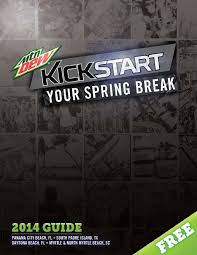
  • PepsiCo Kickstart’s Spring Break 2014

    At the start of every year, the Collegiate Marketing Group publishes a Spring Break Guide for college students across the nation. The guide was first published in 1992 providing travel tips, destination news and information on everything about Spring Break.

    kickstart

    The Collegiate Marketing Group specializes in the youth market and basically owns all territory related to Spring Break marketing. Their Spring Break Guide reaches an estimated one million students including the print and web publication as well as the students on social media.

    This year, Pepsi’s new Mountain Dew energy drink, Kickstart, is the featured annual sponsor, replacing Coca-Cola. The shift in sponsor seems to be due to PepsiCo’s efforts in supporting the Mountain Dew brand.

    kickstart2

    Kickstart was introduced in February 2013, and sales surged to more than 100 million in the first 6 months. PepsiCo is planning on supporting Kickstart even more in year two. Kickstart was given a 35% media spending boost compared to its first year on the market.


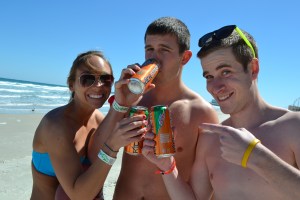
    This 35% can already be seen through the increased spring break advertising PepsiCo has been sponsoring. There are a number of things that PepsiCo reveals about themselves by choosing to spend their marketing budget on college spring break guides.  The first is that it identifies PepsiCo’s target audience for this campaign. A second thing is they are trying to associate this drink and its brand with the spring break scene (party, lights, sun, fun, etc).

    kcikstart3

    While these 2 things stand out, there are many other things to examine in this campaign.  While you are on spring break, will you notice Kickstart and give it a try? We’ll see how PepsiCo and Kickstart do with their promotional campaign.

    – Rachel Gracy & Greg Rothman

  • #VersaceLovesGaga

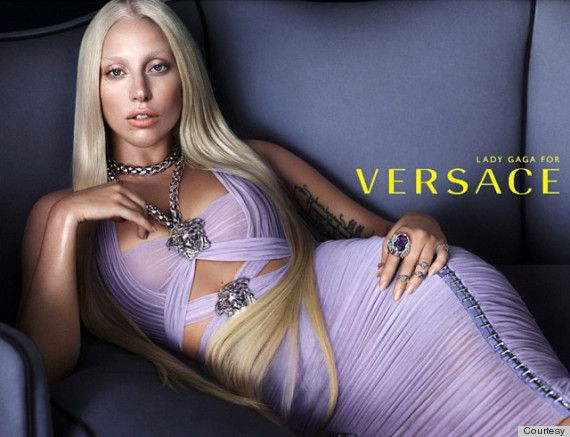
    Ever wonder what could happen if two fashion superstars like Donatella Versace and Lady Gaga got together?  They would open up a whole new world of consumers to both of their brands.  Versace is a well-known luxury clothing brand that been around since 1978.  The head lady in charge now is none other than Donatella Versace herself.  Although Donatella is distinguished as a talented designer, it’s her vibrant persona that makes her even more famous.  In recent years Versace usually went with non-famous models in their ad to focus more on the clothing instead of a celebrity name on it.  This spring fashion season Versace is trying a new campaign with Lady Gaga as the focus.

    This change up in the ad routine of Versace is very positive considering the social power these women have.   In leading up to this announcement, the two have been seen together everywhere.  This new well established friendship is great for the Versace brand.  Lady Gaga is a very influential woman not only in music, but in fashion.  When someone thinks of Gaga, their first thought is “I wonder what she’s wearing this time?”  She has a major advantage because of her power to expose this brand as much as possible.   Versace is thought of more as a mature brand, but with Lady G’s influence over a younger generation this can reel in a completely different group of purchasers then before.

    Lady Gaga is quite possibly a twenty-four hour ad campaign for the Versace clothing brand.  She is constantly being photographed in this brand that is then exposed all over the internet and in magazines.  She truly has embraced the product, she is being paid to promote to exact detail including her new Donatella look.

    Not only do these ladies have reach on tabloids, but their social media sites are a huge way to endorse the company as well.  The combined followers on twitter for Versace and Gaga is over forty-two million people.  The two are always promoting one another on various media sites, creating this whole new revolution for Versace. Including a personalized hash-tag for the Versace endorser herself, #VersaceLovesGaga.  This has been trending all over twitter, just proving how much influence she has also in the cyber world. This seems to be an extremely beneficial partnership for both brands and we’ll continue to see growth in Versace and Lady Gaga this fashion season.

    Melissa Shampoe

  • Marc’s Makeover: Marc Jacobs’ decision to rebrand… is it the right one?

    Deciding whether or not to rebrand your company is an immense decision. Your brand is the face and personality of your company. It is what viewers connect with. Changing this identity will greatly affect your company, but if done right the market can soar.

    Fashion designer Marc Jacobs has decided it is time for his company, Marc Jacobs International to rebrand. In an interview with David Amsden from W Magazine Jacobs explains the troubles the Marc Jacobs brand had encountered. Describing the brand as having been “diluted” from his lack of creative supervision and merchandisers pushing his design team.

    In order to fix this Jacobs decided to leave his position at Louis Vuitton to grow his company, which includes boutiques, clothing lines such as Marc by Marc Jacobs and Little Marc Jacobs (a children’s clothing line), Bookmarc (a bookstore), and more.

    Some changes have already taken place such as his decision to move his offices from Manhattan to London and his decision to part with longtime campaign photographer Juergen Teller after he creatively disagreed on the Spring 2014 ad campaign which features Miley Cyrus. 

    marcmiley

    So what is Jacobs looking to do? He’s looking to redesign the logo and packaging, to build his shoe and handbag lines, and maybe even change the name, which he told W Magazine that he had always hated.

    Rebranding can be daunting between redefining research, audiences, creative campaigns, and even products, but for those experiencing continuous losses, it is often the best way to launch back into the market.

    In recent years, another clothing line, Burberry, underwent a widely recognized successful rebranding campaign. Over the years, the British line went from being known for its historically iconic outwear, to being associated with cheapest form of high fashion, and even gang wear.

    In 2006, the company hired Angela Ahrendts and in the next six years, she turned the ubiquitous brand back to luxurious. First, Ahrendts did what she called “buying back the company.” Reigning in the 23 licenses Burberry had around the world, control was brought back to the company with centralized executive and creative offices that could maintain product authenticity and exclusivity.

    Secondly, Ahrendts recognized we are in the age of digital consumption and a digital generation – tapping into the resources social media and technology offers. In stores, sale assistants are equipped with iPads, and mirrors transform into screens displaying catwalk images. Online, the company continues to grow its presence, attracting over 16 million fans on Facebook, and over 2 million followers on Twitter. Burberry also uses YouTube to broadcast campaigns, events, music, and even corporate news. 

    However, rebranding is not exclusive to high profile companies, the challenges above are things that can be experienced in all types of companies: personal, mid, or large. So how do you know if you should rebrand your own company? From Katie Morrell’s article “10 Signs You Should/Should not Rebrand” here are some warming signs that your company should rebrand.

    Macro problems

    Maria Ross, author of Branding Basics for Small Business: How to Create an Irresistible Brand on Any Budget (2010, Norlights Press) suggests that if a company notices that their target customers are choosing the competition over their own company and if a decrease in sales is also trending, rebranding should be considered.

    Look and function don’t match

    Another element that should be considered when having a decrease in customers is “From a cosmetic point of view, when you look old and your looks don’t reflect what you are or what you deliver, it may be time to rebrand,” said Susan Betts, senior strategy director for New York-based FutureBrand North America.

    Attracting the wrong customers

    Rebranding is beneficial when a company wants to change their target customers. It gives a company an opportunity to create a new brand identity that the new target audience has the chance to connect too.

    Management change

    When a company changes management, it is normal that policies and values change as well. When a companies values change, rebranding is a good idea.

    Philosophy/function change

    When a company changes it’s direction, rebranding can showcase to customers what they may or may not be aware of concerning this change. Betts also mentions rebranding should be considered when a company has a “New philosophy or a changed philosophy”.

    These signs are great examples to take heed from, but it is important to note rebranding should not be done unless it has been proven your brand identity is the root of your problems. Branding is the largest initial investment for a company, it sets the spring board for your identity, association, and customers. Rebranding is an even bigger investment – an attempt to reintroduce ideas to already established and preconceived perceptions is no easy task, it is one that must be thoroughly strategized. For Burberry, reigning in and refining their identity proved to be the best decision the company has made. For Jacobs, we will see what his creative vision produces.

    What companies do you think have faltered recently or over the years? Who needs to rebrand?

    Caroline Robinson, Savannah Valade, Elizabeth Harrington

  • Ambush Marketing, Rule 40, and the Sochi Controversy You Aren’t Hearing About

    Have Olympic advertising partnerships gotten too big? Have rules and restrictions protecting these “official sponsors” gone too far?

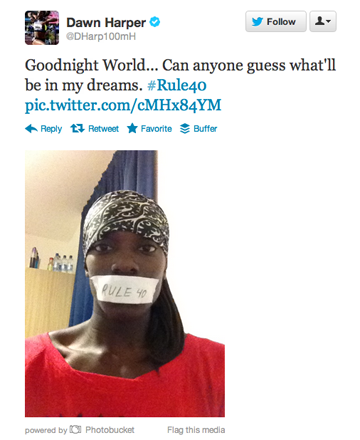
    Dawn Harper Tweets her Opinion of Olympic Rule 40
    Dawn Harper Tweets her Opinion of Olympic Rule 40

    Two-time track and field medalist Dawn Harper thinks so.  That’s why she posted this tweet with #Rule40 in protest of the IOC’s infamous Rule 40 during the 2012 Olympics in London.

    If you aren’t yet familiar with Rule40, it is a total ban on an athlete’s promotion of personal sponsors and their ability to acknowledge those who helped them get where they are today. It is especially focused on social media, where it has become a commonplace for athletes to thank sponsors with pictures and personal statements.

    Harper isn’t the only athlete to voice her displeasure with the effective “gag order” on competitors, but with companies spending upwards of $100,000,000.00 to associate their brands with the Olympics Games, is it really that hard to see why #Rule40 is in effect?

    Some have even gone as far to refer to the situation as a “battle”. Yet, despite the activism surrounding #rule40, without a doubt the biggest threat to the official Olympic sponsors is the ever-pervasive ambush marketers, silently stalking and waiting for their chance to steal some the Olympic brand name.

    These controversial ambush marketing campaigns attempt to capitalize on high-visibility events and locations through brand association without having to pay for the high-cost of officially sponsoring an event. My favorite example of ambush marketing involved the Minnesota Timberwolves selling this advertisement on the side of their stadium, where it happens to only be viewable from inside the nearby Minnesota Twins baseball stadium (where the official sponsor is Target).

    View of Timberwolves basketball stadium from inside the Twins baseball stadium
    View of Timberwolves basketball stadium from inside the Twins baseball stadium

    Ambush marketing may have been around in the advertising world for years, but the Olympics are seen as “the flagship event for ambush marketing”. Creative campaigns by infamous ambush advertisers like Nike often times attract more online buzz and conversation than the actual official sponsors.

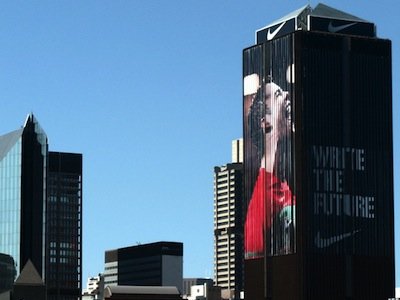
    During the 2010 World Cup in South Africa officially sponsored by Reebok, advertising juggernaut and infamous ambush marketer Nike, placed an eye-catching ad on the fourth tallest building in the entire city of Johannesburg. When paired with a lengthy viral video, many agreed that Nike had effectively hijacked the sponsorship from Reebok and gained closer brand association with the World Cup event.

    Nike ad in Johannesburg during World Cup 2010
    Nike ad in Johannesburg during World Cup 2010

    Another ambush marketing giant, Subway, has already launched its attempt to steal some association from the upcoming Sochi games.  Summer Olympian Michael Phelps and retired speed-skating icon Apollo Ohno both appear in TV commercials for Subway’s “$5 foot long campaign” due to some legal loopholes discovered by Subway.

    So is it reasonable for the IOC to implement Rule 40 to help protect sponsors? Freeskiier David Wise recently commented that, “[he] understand[s] the Olympics are a moneymaking game, but it’s sad for [him] to have all these sponsors who have really taken care of [him]…[he’s] on the biggest stage [he] can possibly be on and [he] can’t give them the representation they deserve.”

    Another athlete and social media enthusiast, Nick Goepper, has stated that he will be completely off of social media for the entirety of the Olympics. “I think it might be safer not to tweet anything,” said Nick, the 19-year-old favorite to win Ski Slopestyle gold. “All I know, it’s pretty much zero tolerance for branding.”

    The Sochi games are only 3 days away, but the media blackout protecting the games’ sponsors has been in effect since January 26. When the final medal is awarded and the closing ceremonies complete, which brands will you associate with the games? Which advertisements and commercials will be the most talked about and discussed? Is $100,000,000 too much to pay for a loose association with the Olympic rings?

    Will the “ambushers” steal the spotlight once again?

    – Greg Rothman