Category: Advertising

  • Snapchat: A New Social Trend For Brands?

    Today, brands dominate social media. It is almost impossible to find a company without a Facebook or Twitter account. Even newer platforms like Instagram and Vine are being taken over, but there is one social network that has yet to be fully explored—Snapchat.

    snapchat

    Snapchat is a mobile app that allows one to share pictures and videos. The special component of this network is that the captioned picture is deleted after 10 seconds; this is much different from the “out for the world to see” social media we are used to.

    The majority of Snapchat users are between the ages of 13-25. This age, as James Twitchell reminds us in his book Lead Us Into Temptation, is the “number one focus of almost every marketer”. Why? Younger demographics are still choosing what brands to align themselves with. A survey sent out by Sumpto, a marketing group that works to gather information about the “most difficult to reach demographic”, found that 77% of college students use Snapchat once per day. Their findings also concluded that 70% of respondents wouldn’t mind adding a brand as a friend on Snapchat if they already followed them on another social network.

    So, why haven’t brands jumped onto this platform? Unlike other social media Snapchat is more intimate and personal— like a text message instead of a public wall. This very direct connection leaves brands with a problem. What type of content could they send via snap? Would people be interested in interacting with them this way?

    DoSomething.org, HBO’s TV show Girls and the Association of Surfing Professionals (ASP) have all been using Snapchat in a variety of ways. DoSomething.org described in an interview with Mashable that their strategy is to make interactive Snapchat stories that are ridiculous and fun. They see Snapchat as a tool for “opening up more options for brands”. The Girls Snapchat account has been used to remind fans of the upcoming season premiere date and give exclusive insider looks.  ASP says Snapchat is a way to “bring fans closer to the athletes and events”. They also point out there is “lots of room for experimentation and innovation”. Click on the image below to learn more about how Snapchat is being used by companies.

    Marketo_Snapchat

    Patrick deHahn from CNN Money stated that Snapchat “has more funding and a higher valuation than Instagram and YouTube when they were at Snapchat’s stage in their startup lifespan”. So it seems Snapchat itself is a viable platform and with a growing 350 million snaps per day, brands should consider its possible benefits.

    Would you follow brands on Snapchat? Do you think Snapchat is a worthy social media investment? How do you think brands will begin to use Snapchat?

    Caroline Robinson

  • IKEA Brings a New Meaning to Reading on the Beach

    IKEA is a company that has made a huge name for themselves all over the world through strategic marketing and advertising campaigns. Last year, IKEA made the decision to take a creative step in making a positive impact by executing a unique guerilla marketing campaign.

    In 2013, IKEA found through research that 1 in 3 Australians loved spending an extra hour each day engaging in a good book. This was also the year that IKEA was celebrating the 30th anniversary of their most popular bookshelf, The Billy. In honor of 30 successful years with the bookshelf, IKEA made the decision to join forces with Australian Literacy & Numeracy Foundation and set up the world’s largest outdoor library in Australia on Bondi Beach. IKEA was enthusiastic about providing the use of their most treasured bookshelf to a community who is passionate about finding good reads. Over 6,000 books were displayed on the popular shelves, and if people wanted to take one they could either donate a book of their own or donate money to the foundation.   

                               untitled

    With consumers constantly bombarded with advertisements each day, IKEA attempted to bypass the clutter and reach consumers by promoting one of their products in this unique marketing campaign. One of the key components to any successful marketing campaign is research, and in this case IKEA used extensive research to target a specific audience: book enthusiasts. Using this innovative and creative approach to marketing enticed book lovers and allowed them to see the promoted product in use. This form of marketing added interest to the company’s brand and helped differentiate themselves from their competitors. Instead of using traditional forms of advertising, they chose to think outside the box and appeal to their target audience in a creative way that would resonate with the consumers.

    untitled

    As we all know, to be a thriving, in demand business you have to advertise. But the costs of advertising have become enormously expensive and can be the most costly part to a company’s success. So businesses are finding new, innovative ways to reach their audiences. Guerrilla marketing is a low-cost, unconventional advertising strategy that IKEA executed ingeniously. IKEA used guerrilla marketing by studying the interests of their consumers and went straight to the source, or the beach, in an attention-grabbing way. Do you think companies should start utilizing unique campaigns for advertising? Can companies today build powerful, enduring brands by using tactics like guerrilla campaigning compared to normal advertising on television or print ads? What do you think the future for guerilla marketing might look like?

    -Briana McWhirter, Emily Foulke, Hannah Turner

  • There’s a New Animal in the Jungle of Advertising

    How do you break through the clutter? That’s the question marketers and advertisers have to figure out with every campaign they produce.

    So how do they do that? By doing something unusual, unexpected, and memorable – guerrilla marketing. First coined by Jay Conrad Levison, guerrilla marketing relies on unique or unorthodox methods of advertising or promotion to gain consumers’ attention. Below is a video by Mango Moose Media displaying a couple of guerrilla marketing techniques.

    Guerrilla marketing is in your face, but there are a couple of core concepts (besides ultimate creativity) that make guerrilla marketing significantly effective. According to Elena English, “the idea is to play on human responses and emotions rather than present a sale, product release, or pitch”. The difference is the highlight on customer interaction with the goal of grabbing their attention, not selling them the product. English also explains guerilla marketing involves “extensive use of humor, lots of visuals, plays on “humanisms” and pop culture references”. So in honor of this, we found two completely different guerilla-marketing stunts that represent these core concepts.

    The “Storm Drains are the MOUTH of the River” campaign was done by the City of Reno to battle the city’s river pollution problem. In 2013, local artist were commissioned to paint storm drains as the mouths of frogs, fish, and octopus. To learn about the campaign and how its effectiveness was measured watch the case study, Art Vs. Pollution, below.

    As the video describes, the campaign worked to “humanize” the storm drains with a pop art style. The utilization of pop art to grab attention is not unknown to the marketing world. James Twitchell says in his book Lead Us Into Temptation that pop art on commercial packaging has been and is still grabbing the attention of consumers. It especially worked well in this campaign in which the cartoon aquatic species brought to life the message.

    All guerrilla marketing doesn’t have to be inanimate objects. Chobani used it to continue marketing efforts for the “How Matters” campaign, which works to position its yogurt as real and natural. Relying on the audience’s knowledge of its Superbowl commercial, Chobani broke through the clutter with a 1400-pound human bear costume.

    This realistic and naturally misplaced bear has gained over 4 million views in less than a month. The stunts effectiveness is due to the memorable bear’s search for food that is natural, which reinforces the brand message.

    Guerrilla marketing is limitless; it can be used for many purposes, such as reinforcing brands or gaining exposure for issues, and in many inanimate or animate ways. Yet, they all have one goal and this is to capture people’s attention. What do you think of these guerrilla marketing strategies? Do you think these companies used them effectively?

    Caroline Robinson, Elizabeth Harrington, Savannah Valade

  • Nike Knows How to “Just Do It”

    Nike, the leader in manufacturing footwear and apparel has been building and strengthening their brand since their first advertisement in 1982. Currently, Nike has become a household name and can be easily recognized by consumers by their iconic swoosh logo. Before running advertisements on television, Nike promoted their brand based on sponsorships and celebrity endorsements, both professional and college athletes. In order to differentiate their company from their biggest competitor, Reebok, Nike chose to promote their shoes as fashion accessories to consumers. They also began to focus their advertisements on the stories of the people wearing the product, instead of solely on the product.

    As their brand was quickly growing, Nike employees decided to sign on with Wieden and Kennedy (an advertising agency) to help promote their brand. The “Just Do It” tagline was created while in a meeting when Dan Wieden (one of the founders) said to the Nike employees, “You Nike guys, you just do it.” With just that one phrase, the history of Nike advertising changed.

    nike-just-do-it-logo

    When the famous tagline, “Just Do It”, was first brought into their marketing scheme, Nike was trying to regain its position as the industry leader. During the 1980s the aerobics industry climaxed giving competitors an open range of new business development within the sportswear industry. In order to show consumers that Nike was different from its competitors, Nike held a major product and marketing campaign in 1987. The campaign was supported by a memorable TV ad whose soundtrack was the original Beatles’ recording of ‘Revolution.’ From the “Revolution” campaign, Nike then launched a broad yet empowering series of ads with the tagline “Just Do It.” The beginning of the “Just Do It” ads was in 1988 when a commercial airing Walt Stack, an 80 year-old running legend, jogging across the Golden Gate Bridge stating that he runs 17 miles every day. In 1989, Nike’s cross-training business peaked and the brand slogan had regained the position as the industry leader back to its rightful owner and has held this title since.

    Nike entered the 1990s decade with a focus on sports players and designing national team uniforms around the world. In the past, Nike has designed apparel and footwear for golf and soccer. Nike decided to expand their sports designs to various sports including basketball, tennis, and football. Nike signed the World Cup winning Brazilian National Team as their uniform designing brand in 1995. Also they signed for the US men’s and women’s national soccer teams as well as many others. Nike also branded its company with by using iconic athletes in their commercials like Michael Jordan, Bo Jackson, Charles Barkley, Andre Agassi, Pete Sampras, and Tiger Woods. In 1996, Nike sponsored the young Tiger Woods a gracious amount of $5 million per year. Tiger Woods proved his golfing abilities to doubtful critics in the 1997 Masters after winning by 12 strokes. “I’ve heard I’m not ready for you. Are you ready for me?” are the final lines of Nike’s obstinate introduction of Tiger Woods. In the 1996 ad titled, “Hello World”, Nike foreshadowed the future dominance the golfing world was about to encounter.

    Nike boomed into the 20th century with the introduction of Nike Shox, which was a whole new type of shoe. Shox provide groups of small hollow columns in the middle of the shoe soles. These columns were designed to add an extra comfort factor to the shoe, as well as a spring that gives more power to an athlete. Shox have been one of Nike’s most successful products throughout their history. They also reinforced the idea that Nike truly cares about the comfort of the athlete. Throughout the 2000s Nike continued to improve their products and put time and effort into the advertising of the products. In 2003 Nike was named “Advertiser of the Year” by Cannes Advertising Festival, making it the first company to hold that title twice (the first time was in 1994). The following year their annual revenues exceeded $13 billion. Their obvious hard work was paying off.

    Within the past 10 years, Nike has introduced several new types of shoes such as the Air Jordan XX and their eco-friendly Nike Considered line. Currently Nike has developed a 5 year plan with their goal being to reach a $36 billion revenue by 2017. They plan to reach this goal by focusing on the growth of the brand and giving extra attention to their women’s apparel. If there is one thing that Nike has successfully done over the last 25 years, it’s expanded and branded their products effectively.

    Nike is a brand that never stops growing and developing. They continuously create goals for themselves as a company and seem know exactly how to keep reaching those goals. What do you remember most about the Nike brand over the past few decades?

    – Hannah Turner, Emily Foulke, Briana McWhirter

  • Big Brother is Watching You FaceTime: 30 Years After “1984”

    apple_1984_ad_5

    On January 24thApple Computer will introduce Macintosh. And you’ll see why 1984 won’t be like “1984.”

    On January 22, 1984, what is widely regarded as one of the greatest television advertisements of all time aired during the third quarter of Super Bowl XVIII. The one-minute spot is a postmodern representation of George Orwell’s 1949 dystopian novel, 1984, which depicts a futuristic totalitarian society stripped of all freedom and individualism.

    In 1983, Apple and IBM battled for market share as the two giants in the computer industry selling over one billion dollars of PCs that year. In 1983, at his company’s keynote address, Apple founder and CEO Steve Jobs made clear that IBM is a fierce competitor gunning to dominate the industry.

    “Dealers initially welcoming IBM with open arms now fear an IBM dominated and controlled future…they are increasingly and desperately turning back to Apple as the only force that can ensure their future freedom.”–Steve Jobs, 1983

    During his address, Jobs unveiled the ad to an exclusive audience for the first time, to thundering applause. The ad, created by Chiat/Day, ultimately positions Apple and Mac as empowering, liberating, and individualistic, unlike the IBM view that computers are nothing more than tools. IBM is gray, cold, mechanical. Apple is colorful, creative, independent. This ad separated Mac to start the “Mac versus PC debate” that is still relevant today.

    mac-pc

    Which of these guys do you picture in an office at IBM?

    In 2009, Hunch did a survey to analyze personality traits between Mac and PC users. They found that Mac users are more likely to see the existing world as the same all the time and want to be seen as different and unique. They are more apt to call themselves “verbal”, “conceptual”, and “risk-takers”.  The Mac brand is still as relevant today as it was 30 years ago at its introduction, and its consumer base reflects it.

    The “1984” ad has also found itself injected into American culture. In 2007, Phil de Vellis used the visuals from the Macintosh ad and made it into “Vote Different”. It uses sound bites and images of 2008 Democratic presidential candidate Hillary Clinton to put her in the role of “Big Brother”—the role IBM took in the original ad. The woman with the sledgehammer that represented Mac became equated to Barack Obama. The video went viral and is a great example of using appropriation to communicate a message.

    From “1984” to “Think different.” to “Get a Mac”, Apple’s advertising for Macintosh has continued to embody the individualism Steve Jobs envisioned for the brand. Now, 30 years after it was introduced, what does the Mac brand mean to you?

    Nathan Evers

  • Out With The Old, In With The New: Technology Decides It All

    Everyday you as a consumer are exposed to hundreds of thousands of brands. Over the decades the shopping industry has exploded with most brands disappearing at the same rate new ones appear, yet some brands have stood the cluttered test of time – one of those is Macy’s.

    Created in 1858 by Rowland Hussy Macy the Macy’s store was originally a dry goods store. Macy’s started to gain notable recognition in the 1900s with its holiday window displays and the hiring of Santa Claus for the stores. In 1924 the store moved to its current NYC location, on the corner of Broadway and 34th Street. This year was also the first Macy’s Day Parade, which was organized to celebrate immigrant employees new American Heritage.

    macys6n-2-web

    In 1944, Macy’s became apart of the Federated Department Stores, Inc., renamed Macy’s Inc. creating the world’s largest department store. Today, Macy’s has 800 stores in the United States and sells merchandise online.

    Macy’s isn’t the only iconic retailer – Sears Roebuck ring a bell? Starting in 1886, the mail order company prospered as it was able to provide low cost alternative to farmers. As mail order plants transitioned into stores, Sears found their place in city life and the retailer soon became a retailer giant. Today the store owns 863 mall-based operations and 1200 other locations including hardware, outlet, tire, and battery stores.

    sears catalogue

    Nowadays Macy’s and Sears are direct competitors, but it seems Sears, the company who invented mail order, can’t quite figure out online order.

    Holiday sales account for a large indicator of profit margins and often depict the health of a company. Sears seems to be in critical condition – US stores suffered a 9.2 percent drop. In decline for some time now, and with little to no improvement, some speculate the store could be gone by 2017.

    The history of an iconic brand is something that should be cultivated in your identity – it induces credibility, shows longevity, and prompts nostalgia. Yet being historic isn’t merely enough to remain vibrant. Iconic companies remain iconic because they are able to cultivate lasting relationships with consumers – at all time periods – and that means evolving.

    Looking at each retailers attempt to reach customers during the holiday seasons could explain Sears 9.2 percent drop in sales. Both have social media accounts, yet social media presence is widely disproportionate. Macy’s Instagram account has 150,00 followers while Sears has two Instagram accounts – “Sears” and “Sears Style” – yet both of the followers combined don’t even reach 8,000. A huge missed opportunity for Sears – Instagram is leading the way in social media, growing faster than Facebook, Twitter, and Pinterest combined.

    According to Gary Vaynerchuk’s article “The Road to Black Friday: Macy’s vs. Sears”, the use of social media by Sears is lazy. Choosing to ignore the social media culture they have posted irrelevant and uninteresting content such as a link to one of their commercials and an original YouTube video. While Macy’s post content that is culturally relevant, trendy, and formed around pop culture.

    Our culture today has switched, as James Twitchell describes it, “In the last generation we have almost completely reversed the poles of shame so that where we were once ashamed of consuming too much (religious shame), we are now often ashamed of consuming the wrong brands (shoppers’ shame)”. In this day in age a brand establishes and remains relevance by relationship cultivation, reinforcement, and engagement forged through technology – the Internet and social media. It seems Sear’s inability to adapt to technology has prevented them being able to participate in the younger crowds culture leading in profit and brand influence. As an American brand we hope Sears can get back into the groove but as they stand now they are the weakest link.

    In what other ways do old brands stay new? Can you think of any others that have had a hard time capturing new generations of shoppers? Or others that have done well?

    Caroline Robinson, Savannah Valade, Elizabeth Harrington

  • PepsiCo Kickstart’s Spring Break 2014

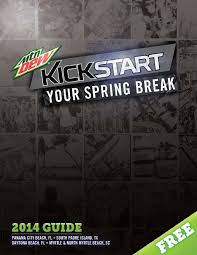
    At the start of every year, the Collegiate Marketing Group publishes a Spring Break Guide for college students across the nation. The guide was first published in 1992 providing travel tips, destination news and information on everything about Spring Break.

    kickstart

    The Collegiate Marketing Group specializes in the youth market and basically owns all territory related to Spring Break marketing. Their Spring Break Guide reaches an estimated one million students including the print and web publication as well as the students on social media.

    This year, Pepsi’s new Mountain Dew energy drink, Kickstart, is the featured annual sponsor, replacing Coca-Cola. The shift in sponsor seems to be due to PepsiCo’s efforts in supporting the Mountain Dew brand.

    kickstart2

    Kickstart was introduced in February 2013, and sales surged to more than 100 million in the first 6 months. PepsiCo is planning on supporting Kickstart even more in year two. Kickstart was given a 35% media spending boost compared to its first year on the market.


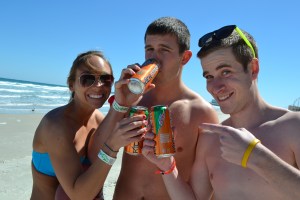
    This 35% can already be seen through the increased spring break advertising PepsiCo has been sponsoring. There are a number of things that PepsiCo reveals about themselves by choosing to spend their marketing budget on college spring break guides.  The first is that it identifies PepsiCo’s target audience for this campaign. A second thing is they are trying to associate this drink and its brand with the spring break scene (party, lights, sun, fun, etc).

    kcikstart3

    While these 2 things stand out, there are many other things to examine in this campaign.  While you are on spring break, will you notice Kickstart and give it a try? We’ll see how PepsiCo and Kickstart do with their promotional campaign.

    – Rachel Gracy & Greg Rothman