Category: Advertising

  • Cucalorus: How to Brand an Independent Film Festival

    Cucalorus: How to Brand an Independent Film Festival

    By Daniel Dawson

    Cucalorus is Wilmywood’s premiere quirky film festival, showcasing independent films from local, national and international artists. Film connoisseurs sporting chunky glasses, artsy students in their thrift-store best and less interesting folk like you and I file into Thalian Hall (or one of the many other venues), settle down and wait for the lights to dim. This November will be the 21st year this little slice of art and culture draws people to downtown Wilmington.

    I could barely convince people to keep coming after my twelfth birthday party, so how does Cucalorus garner a big crowd each consecutive year? A cohesive brand narrative, that’s how. And Cucalorus’ brand narrative is nothing short of weird—but in the good way. Let’s explore what makes Cucalorus cool.

    1. It’s in the copy

    While none of these factors are ranked in any specific order of importance, I am a word person and always like to read and evaluate the voice of an organization. Many organizations forget about this, not capitalizing its subtle importance. Bad organizations.

    Cucalorus, on the other hand, has got its copy down pat. The copy, whether it’s online, in print or broadcasted on the radio, is how an organization communicates not only its news or events, but its personality, its voice and its image.  Here’s a snippet of copy from Cucalorus’ donation page on their website:

    “Hey Cucalorians!!! Do you need to get rid of unwanted cash? Make a donation and we’ll send you a tax deduction letter to send your fuzzy little friends at the IRS (they don’t need your money and clearly don’t know what to do with it!!). We do know what to do with it – we’re already plotting and scheming for the 21st annual Cucalorus Film Festival – taking place November 11-15, 2015!!! Help us fund the dreams and visions of artists all over the world by making a donation today.
    Dreaming of eggnog omelettes!
    Cucalorius.
    The Cucalorus Film Foundation is a 501c3 non-profit and your donation is tax deductible to the fullest extent of the law.”


    On first glance this might sound unprofessional and not the voice an organization would want to convey. The context, though, is important. Cucalorus’ audience is mostly the aforementioned artists, hipsters and independent film connoisseurs and Cucalorians. These types of people generally like funny, creative and quirky things (like Cucalorus). These types of people also tend to be skeptical of the IRS—not to mention the state cutting NC’s film incentive last year.  So yes, it might be OK for Cucalorus to be a bit irreverent, and it’s their creative risk.

    1. Digital presence, dude

    If your business doesn’t have some sort of online presence (an email address counts), I would like you to write to me immediately by carrier pigeon and explain how you’re still surviving. An online presence is increasingly important each year, and now just having a website and Facebook isn’t cutting it. Brand cohesion across appropriate social media networks and inter-connectivity between them is vital.

    Cucalorus not only has a website, Facebook, Twitter, Pinterest, and Instagram but their own blog and—drum roll—they are all updated. Bravo, Cucalorus. Content creation and audience engagement are essential to a successful IMC strategy.

    1. Creepily consistent image

    This one is tandem with the digital presence. IMC consists of advertising, public relations, marketing and every other single communication an organization can perform with its publics. Consistency in corporate communication allows the organization and its audiences to construct a narrative and image of the brand. This is what people can relate to. This is how we can see the quirkiness, irreverence and artsy personality of Cucalorus as if it were that weird kid in your English class who would always have some snappy reference to an obscure book even your professor hadn’t read. But less annoying.

    Take a look at Cucalorus’ official website:
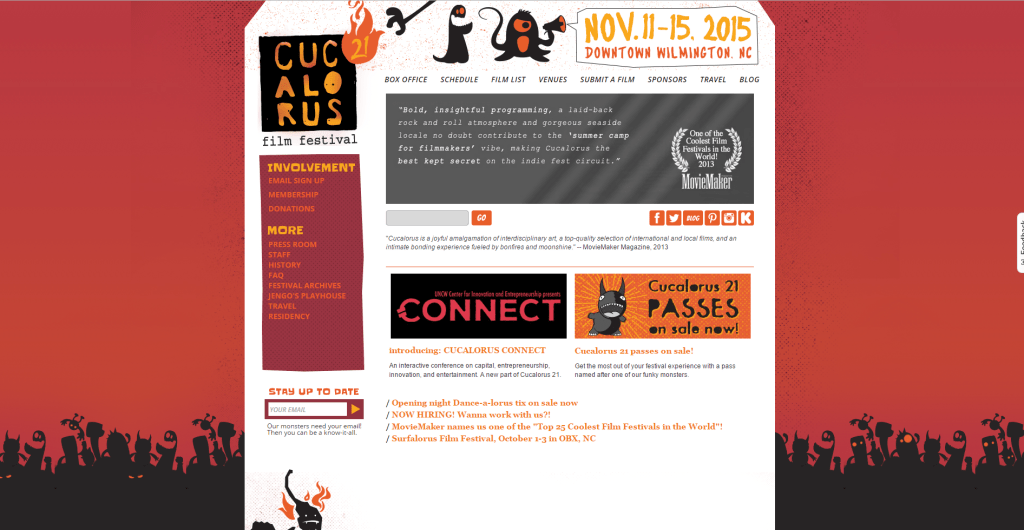
    Cucalorus Home Page - Wilmington, NC
    Ooh, warm fall colors. Where’s my PSL?!

    The color scheme and design is consistent. The font-faces, graphics and little cartoon dudes are consistent. There’s well-organized navigation and that copy I was talking about earlier. The social media pages follow suit. There’s an article on this if you’re into academic papers. Basically, the author, Simon Torp from Odense University in Denmark, says that as an organization your communication through all channels must be consistent, accessible and in line with your self-image, public image and meta-image for people to take you seriously.

    1. Zany staff workers

    When I said all channels of communication, I meant all of them. Even the staff workers and volunteers need to be carefully selected and even briefed on an organization’s code of conduct. One time I went to a screening of a Cucalorus film at Thalian Hall and, not to get into too much detail, I, with the rest of the audience, was sternly asked by staff to partake in a ritual involving whipped cream, button pins and our tongues. Was I offended? No, but I could have been if I had been misguided by thinking Cucalorus was actually a convention for neo-Puritans. Because their self-branding and self-image don’t suggest that, I could expect something out of the ordinary. It’s the risk that Cucalorus takes to maintain its image and appeal to its target audience.

    1. High-quality product

    When it comes down to it, a business or organization is only as good as its product. Silly brand narrative and image aside, Cucalorus does a good job at what it does. It recruits and selects excellent film talent from around the world and showcases it in quality and entertaining venues. This is where word-of-mouth comes into play. Word-of-mouth marketing or WOM is an organic and invaluable means of public relations, advertising and marketing. Have you ever read a positive news story about an organization you love? Or has a good friend of yours recommended a product or service they favor? These are examples of WOM that can make or break an organization depending on whether they are in favor or against it.  Maintaining the balance between brand narrative, professionalism and good business sense is how an organization thrives. While Cucalorus does an outstanding job of its own branding and controlled media, its reputation for quality and intrigue reign in filmmakers and spectators every year.

    I am no way affiliated with the Cucalorus film festival professionally, nor do I represent it. I recognize good IMC in organizations and talk about it here. But, if you are tired of what the local theaters are playing, check out a showing of something interesting between November 11 and 15 downtown at Cucalorus.

  • A.C.E. – Your Source for Campus Entertainment

    Please nod your head if you have ever taken another route to class pretending to be on your cell phone or completely ignoring someone who was trying to give you an event flyer. If you give your computer screen a nod, we applaud you.  However, if you are like 99% of the student population at UNCW and nodded your head–we understand.

    There are over 250 student organizations vying for our attention, membership and time so how do we pick what to attend? Our choices depend on how, or if, we hear about the event and how creative the marketing is. The Association for Campus Entertainment is the university’s student programming board Did you enjoy Hoddie Allen last year? That was ACE. What about when Maci Bookout from Teen Mom was here in the spring? That was ACE too.

    In the midst of everything college kids have going on, ACE provides an outlet for free entrainment. But just like every other student organization, they have to compete for your time as well. Integrated Marketing Communication, IMC,  allows us to diversify the means by which we achieve our marketing goals. A public relations campaign? Check. Social media presence? Also check. Cool and engaging advertising? Also IMC.

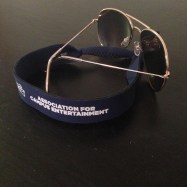
    ACE does this through an array of promotional tools each year, the first being through giveaways what college student doesn’t like free things? This year ACE gave phone wallets, Croakies, car USB adapters and staplers. This may seem like a mishmash of items but each one served a purpose: to be seen and get the ACE name known. Whether it is letting a classmate use the ACE braded stapler, or paying for food in Wag as you pull your OneCard out of your ACE branded phone wallet, ACE is marketing their brand. The goal is to increase the number of times a student sees a brand and how they associate it—hopefully in a positive light.

    image1

    There is more to promotions than simply getting a name out; ACE must also promote their events. There are the standard campus marketing methods such as banner, chalking and flyers, but in order to infiltrate the calendars of college students, you must take efforts farther. ACE is a brand that thrives on creative promotions, whether this be acting out a scene from an upcoming movie in the campus theatre or handing out paint brushes across campus for a Cheerwine and Design event. There is always something being passed out.

    A successful marketing campaign goes beyond creating and implementing the campaign. The ultimate goal of IMC, is to not only change one’s beliefs, but to change his or her actions. Whether this be successfully convincing students to change their plans and attend an event or sign up for ACE, we want them to act on our suggestions. So how do you think ACE stacks up, do you hear about their events through traditional means of advertising or through creative promotions across campus? Furthermore – how do you prefer to be wooed into coming to an organization’s event or do you organically decide to attend? Let us hear your thoughts and comments blow!

    -Amanda, Daniel, Kendall, Meleah and Luke

  • Tailgating Musts or Bust

    Football season starting up and so are the advertisements. Target, Dicks Sporting Goods, and Best Buy are some retailers advertising “essentials” for game day and football season in their print ads and online.

    Screen Shot 2015-09-06 at 2.58.57 PM

    http://www.dickssportinggoods.com/home/index.jsp

    By defining particular items as necessities for football season and tailgating, retailers are creating their own definitions of tailgating and narratives of what the tailgating experience should be like for consumers.

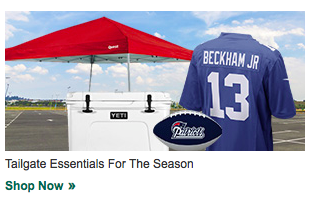
    Target’s ad includes food items such as pre-made pizza and Coca-Cola, but also advertises TVs, grills, and fan gear. Dicks Sporting Goods’ ad includes pop-up tents and chairs, fan gear, coolers, and tailgating games such as corn hole. With Best Buy, all of their “necessities” are electronic – including cameras, speakers, televisions, and cell phone cases.

    Screen Shot 2015-09-06 at 3.02.12 PM

    http://weeklyad.target.com/site/#/wilmington-nc-28405/page/Target-150906

    By showing consumers products that are considered “game day essentials,” retailers are building their own narratives about the tailgating experience. Each retailer’s idea of what commodities that experience requires may be different based on the products sold at each business and their target audiences. Those that want the full experience are more likely to buy into a store’s ad and purchase the products retailers suggest.

    It’s not necessarily about what the consumer realistically needs for a tailgate. These ads for “must have” items are more about creating an idea that makes a consumer feel that without those items, they aren’t getting the best game day experience.

    These advertisements are an example of how today’s market is controlled by commodity culture – we define ourselves by the stuff that we buy. Typically, big businesses are able to sell higher ticket items based on a consumer’s need to feel like they fit in. Both the beginning of football season and the end are big opportunities for retailers to convince consumers that these products are what they need for the perfect football celebration. Football fans define themselves by having the best game day items for the season; new TVs, new grills, new gear, new everything. Retailers are ready for football season, and now the fans will be too.

    -Amanda Kluttz, Kendall Catterton, Meleah Lewis, Luke Matheney, and Dan Dawson

  • Brands – The Biggest Fans in the Game.

    According to ESPN.com, 49 percent of Americans are football fans…but just in case you’re not among them, football season can also mean a whole new ball game in the world of advertising.

    Companies will capitalize on anything they can and football season is no exception. Brands launch new campaigns both in preparation for, and during the season, in order to take advantage of the huge draw from football audiences. By gearing their products and services towards this huge target market, companies can add a new segment to their customer base regardless of whether they are directly related to football or not.  Advertisement strategies will range from direct involvement through sponsoring the NFL to simply trying to profit off the hype.  Football fans who are considering the Bojangles 20 piece jumbo tailgate special now have extra incentive to make Bojangles their game day choice. Bojangles is embracing football season with their second year of offering up football shaped Bojangles biscuits. These tasty bites are available for a limited time until September 26th.

    Boberry

    While food and football go hand in hand, make-up is a less traditional, yet still relevant way to show your team spirit.

    CoverGirl’s 2014 campaign featured a series of makeup and nail designs that represented each of the NFL teams colors and mascots. Inviting women to “Get your Gameface on” CoverGirl found an effective way to include their target audience, possibly otherwise ignored, in the team spirit so many Americans feel during the pro football season. This campaign is a prime example of the diversity of brands using football as a marketing technique, proving even CoverGirl is more than just a pretty face.

    covergirl

    ezebel.com/covergirl-on-nfl-sponsporship-we-support-female-empowe-1635251344

    Brands are not just incorporating football into their advertising campaigns but turning to social media for game day participation. During the 2013 Super Bowl, the power went out in the Mercedes-Benz Superdome while the Saints played against the Ravens. Minutes after the power outage, Oreo took to Twitter and posted “Power out? No problem. You can still dunk in the dark.” The tweet generated more than 15,000 retweets and according to www.mashable.com won respect for making the most out of the blackout situation. Other companies that took to Twitter during the power outage were Tide with their ad, “We can’t get your blackout. But we can get your stains out.” Jim Bean also got in on the hype via Facebook with their ad, “In case you missed the memo… tonight’s big game ‘power outage’ was brought to you by Jim Beam Black.”

    Dunk-in-the-dark

    http://wemedia.com/2013/02/05/lights-out-oreos-super-bowl-dunk-in-the-dark/

    Some people welcome football season in for the games, while others may find creative brand efforts to be the real source of entertainment. What’s your favorite football related campaign?

    -Carey Poniewaz, June Wilkinson, Aki Suzuki, Carey Shetterley, Alexis Trimnal

  • One Country Painted Red

    With the rapid growth of new products, brand extensions and the blurring of traditional and new age advertising, marketing and advertising to target audiences has reached a new level of competitiveness. Brands now must adapt to this changing environment and contest with competitors to stay at the top of their market and target to audiences in creative, attention-grabbing tactics.

    The most iconic brand in the soda market, and throughout the world, is undoubtedly that of Coca-Cola. In the summer of 2011, Coke created an original marketing strategy to run a campaign that would inspire people to connect with the brand both online and offline in order to acclimate to the changing marketing environment. The campaign’s prime objective was to increase consumption of Coke over the summer season and to get people to fall in love with the iconic brand again. Particularly, in Australia, at the time nearly 50% of teens and young adults had never tasted a Coke and this drove the brand to reconnect with the country.

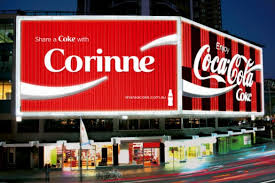
    Established in Australia, the ‘Share a Coke’ campaign immediately received positive media attention and consumer responsiveness. The idea of the ‘Share a Coke’ campaign was to place Australia’s 150 most popular names on the front of millions of Coca-Cola bottles, simple right? This was the first time in 125 years that Coke had made such a paramount transformation to it packaging, and it was revolutionary.

    “We used publicly available data to review the most popular names in Australia and ethnic representation in Australia to ensure the diversity of our multi-cultural nation was represented appropriately.”

    – Coca-Cola Spokesperson.

    The Coca-Cola brand wanted to initiate conversations by putting Australians front and center and inspire them to connect with people and ‘Share a Coke’. The central theme that gave ‘Share a Coke’ its power was the way a brand so universal could replace its logo with individual names by reaching out to consumers and personalizing its brand to individuals.

    “We are using the power of the first name in a playful and social way to remind people of those in their lives they may have lost touch with, or have yet to connect with”

    -Lucie Austin, Marketing Director for Coca-Cola South Pacific.

    The ‘Share a Coke’ campaign strategically exhibited that when personalization in advertising is done the right way, it can be highly appealing and extremely effective. While Coke got personal, media was buzzing with talk over what the brand was implementing behind the personalization. Coke remained silent until Australia’s highest rated media weekend. The campaign was revealed to the public and aired across the biggest weekend in Australian sport, during the AFL (Australian Football League) and NRL (National Rugby League) grand finals which reached over 30% of the population.

    Succeeding the campaign launch, requests for more names were coming in the thousands. Coke was prepared for this boom of requests by setting up kiosks that toured 18 Westfield shopping centers attracting consumers to personalize any name on a Coca-Cola bottle.

    Coke wanted to especially reach out to the 50% of young adults that had never tasted a Coke in Australia, and there was no better way to reach this target market than online. Participation and mass allocation was achieved through Facebook by providing consumers with the resources to connect and ‘Share a Coke’ by creating a personalized virtual Coke bottle to share with a Facebook friend. Consumers were tagging friends in pictures with personalized Coke bottles and sharing stories on social media platforms like Twitter, Facebook and YouTube. Coke consumers also could create their own commercials! With the abundance of requests still pouring in, Coke told consumers to put in a vote of “who do you want to share a Coke with the most?” via Facebook. After 65,000 people voted, Coke bottles with 50 new names were released. “Consumers were invited to SMS a friend’s name, which was projected live onto the iconic ‘Coca-Cola’ sign at Sydney’s King’s Cross. They then received an MMS enabling them to share their friend’s name up in lights, via Facebook and email.”

    untitled

    The multi-platform communications strategy was implemented to ‘Share a Coke’ with someone you know, or want to know and ultimately gave people the resources to find, connect and share. After 3 short months of running the campaign, young adult Coca-Cola consumption increased significantly in Australia by up to 7%, making 2011 Coke’s most fruitful summer season in history. The ‘Share a Coke’ campaign resulted in 76,000 virtual coke cans shared, 378,000 extra coke cans printed at kiosks, and 5% more people were drinking coke. Coca-Cola had successfully won over Australia and became a part of popular culture again.

    -Briana McWhirter

  • See the USA in Your Chevrolet, or See China in Your Buick

    Baseball, hot dogs, apple pie and Chevrolet. That line from this 1970s ad for Chevrolet exhibits the brand’s position as an American icon.

    Fast-forward several decades, and General Motors’ Chevy is still an iconic American brand. Meanwhile, in China, the Chevrolet brand is still young. Chevy is China’s seventh-best selling brand, although two models, the Cruze (sold in North America) and the Sail are strong sellers.

    While Chevy is still catching on in China, another longtime GM brand from the United States holds popular: Buick.

    lugzaoaf2otau1jrolprYou may be asking yourself: Buick? Isn’t that the car for old people? Not so the case in China! In 2013, four times as many Buicks were sold in China than in the U.S.  Nearly 810,000 Buicks were sold in China, compared to over 205,000 stateside.

    What explains Buick’s popularity in China? The answer is rooted in the early 20th century when important Chinese government figures such as president Dr. Sun Yat-sen, premier Zhou Enlai, and emperor Pu Yi either owned, drove, or were driven around in Buicks. This historical background adds to Buick’s image of upper class and prestige. Their advertising uses images of success to propel Buick to a high-end brand, such as in this Buick Excelle ad from the 2000s.

    Establishing global brand coherence has its difficulties. To contrast, in the United States, Buick is having trouble shaking off the “55-to-dead” demographic, and they tackle that problem in this new ad that features the demographic commonly associated with the brand in the U.S. with the desired target demographic in the driver’s seat of the brand-new 2014 Buicks:

    GM isn’t the only American automaker popular with the Chinese. Ford’s sales in China rose 49 percent in 2013, and the Ford Focus was China’s best-selling car that year. NPR interviewed 32-year-old Li Ning, who said he bought a Focus because he likes its muscular American style. In China, Ford is establishing its image as young and trendy.

    chinaford2_wide-852ed1ca329096cde3278d9430a4ed11fd559123-s40-c85

    Auto China 2014, the Beijing International Automotive Exhibition, kicked off on April 20th and runs until April 29th. At Auto China, Ford is introducing a luxury brand familiar to Americans—Lincoln.

    LincolnThumb_1398177154

    Lincoln’s model of selling cars in China is called “The Lincoln Way” and features luxurious showrooms that feel like a five-star hotel. Lincoln plans to focus on building customer relationships by understanding and fulfilling their needs. Lincoln may bring this style of personal selling to the U.S. based on how it works in China.

    Only time will tell if Ford’s effort to introduce the Lincoln brand to China will be a success. Will it become a competitor to Buick, which is already established as a strong luxury brand in China? Are there other ways in which this is an example of globalization?

    Nathan Evers

  • We Love Our Moms (And So Do Advertisers!)

    With just a couple weeks until another one of the biggest card holidays, Mother’s Day, card companies are gearing up their promotions. Last week, American Greetings released their new ad, “The World’s Toughest Job” and with over 14 million views in just one week, it’s safe to say the video has gone viral. This call to action is sure to have you considering whether or not to switch from Hallmark to American Greetings this year.

    Prior to this advertisement, American Greetings ads consisted of mainly cute animals – much like the ones you can find on their actual greeting cards. What these ads were missing were what this recent ad captured – emotion evoking concepts – something competitors such as Hallmark have been relying on and capturing for years. See Hallmark’s “Proud Mom” ad below:

    Yet, it seems that even Hallmark couldn’t capture the raw emotions that the Mullen Agency was able to evoke from the interviewees – simply starting with a job posting and 24 interview candidates. The finished piece was a compilation of honest reactions that left viewer’s hearts melting.

    The American Greetings’ spot isn’t the only ad that has played on the love and appreciation of our mothers this year. Proctor and Gamble’s “Thank You, Mom” series showed the mother as much a part of the Olympics as the athletes themselves. Several other companies including British Airways and General Electric have recently produced ads centered on mothers.

    So what do these “tribute to mom” ads tell us and why do our hearts warm when we watch them? Understanding how advertising works tells us the answer. Ads tell us what is virtuous and what is our ideal world. These “shout out to moms” tell us what we virtue – the compassion mothers have and the love families have for their mother. In the ideal world, that appreciation would be shown by a card everyday, but since this isn’t the ideal world we hope to make it up on Mother’s Day.

    So what do you think about all these ads centered on Mothers? Is it ethical to exploit this relationship that our society holds so valuable? Will you turn to buying an American Greetings card this holiday or stick with Hallmark?

    Caroline Robinson, Elizabeth Harrington